Captainfieldmouse

Novice Member
Joined
Oct 2, 2025
Messages
20
Reaction score
2
Points
5
Location (town/city + country)
Peebles
Driving
HS PHEV
Had my HS PHEV now for 5 months, and whilst it's a very pleasant car to drive, I'm a little disappointed with the fuel consumption, or more specifically the interaction between the battery and the ICE.
I've got it set to HEV mode, but it doesn't seem to matter whether I'm doing short or long runs it seems to default to battery first then the ICE kicks in when I'm down to around 28 miles on the battery. From then on the ICE is on 80-90% of the time on its own.
I would have expected a more even battery/ICE load so they're both 'helping' each other. At the moment the car is an EV for the first 50 miles then pretty much an ICE the rest of the time. There's really not much hybrid going on here at all. Hence my mpg is around 38, nowhere near the optimistically advertised 155.8!
Am I missing a trick here?
TIA
 
You just have to intervene manually a little, whether it's HEV or EV.
I've had mine since 25 July 2025 and have driven 6,000 km so far. In the summer, I only drove in EV mode and always drove around 100 km electrically (in Germany we only have a 21 kWh battery, you have 24 kWh).
Now in winter, I switch to HEV for certain routes that drain the battery a lot. Once I've completed these routes, I switch back to EV.
For the 6,000 km, I am now at 2.7 l/100 km and 14.5 kWh/100 km.
Now in winter, my consumption is up to 5 l/100 km and 25 kWh/100 km.
I find it unfavourable to drive in pure HEV mode, but that also depends on your driving profile.
Assign HEV/EV to one of the star buttons on the steering wheel and test it out a little.
 
You just have to intervene manually a little, whether it's HEV or EV.
I've had mine since 25 July 2025 and have driven 6,000 km so far. In the summer, I only drove in EV mode and always drove around 100 km electrically (in Germany we only have a 21 kWh battery, you have 24 kWh).
Now in winter, I switch to HEV for certain routes that drain the battery a lot. Once I've completed these routes, I switch back to EV.
For the 6,000 km, I am now at 2.7 l/100 km and 14.5 kWh/100 km.
Now in winter, my consumption is up to 5 l/100 km and 25 kWh/100 km.
I find it unfavourable to drive in pure HEV mode, but that also depends on your driving profile.
Assign HEV/EV to one of the star buttons on the steering wheel and test it out a little.
I guess my point is that there should be more intelligence in the management of EV and ICE, I shouldn't really have to manually switch between EV and HEV. I have driven mild hybrids and full hybrids before (Skoda Octavia and Ford Kuga) and there is a much stronger collaboration between the battery and engine in both. I agree the battery has to work harder in winter as there is more of a drain for heating, AC and windscreen demisting, but all year round with the Kuga I was getting 70-80 mpg and it has a much smaller battery. In addition I am having to charge the MG HS battery 2 or 3 times a week to reduce my fuel consumption which is inconvenient to say the least, and costly at £3.50 per charge.
 
I completely agree with you! I also had the Kuga Phev before, and despite its 2.4L petrol engine (without turbo), it was more economical. The switch between petrol and electric was also much smarter than in the MG. Unfortunately, I was somewhat blinded by the HS's longer range. In hindsight, the Kuga was the better car, despite its smaller battery.
 
I have a Landrover Discovery Sport which I use to tow my 2000kg caravan, it's beautiful car. When that dies I'll be buying a full hybrid (not PHEV). Like you I was seduced by the battery size and advertised fuel consumption of the MG. Never again!
 
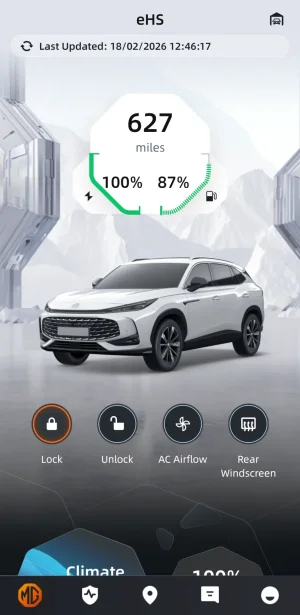
I just keep mine in EV mode and charge it at work, and sometimes at home. After about 500 miles of driving, I’ve only used around 13% of the fuel. As long as you don’t have a heavy foot, it stays in electric mode most of the time.

My old Mercedes did offer more drive mode options, but I generally left that in electric mode too. The longest range I’ve managed on electric alone so far is about 65 miles, even with the heating, lights, and everything else on. Merc would have been half that this time of the year.

I've yet to go further afield though. We have a Southampton trip in April and Scotland in September!
 

Attachments

  • Screenshot_20260218_132239_MG iSMART.webp
    Screenshot_20260218_132239_MG iSMART.webp
    78.2 KB · Views: 16
I just keep mine in EV mode and charge it at work, and sometimes at home. After about 500 miles of driving, I’ve only used around 13% of the fuel. As long as you don’t have a heavy foot, it stays in electric mode most of the time.

My old Mercedes did offer more drive mode options, but I generally left that in electric mode too. The longest range I’ve managed on electric alone so far is about 65 miles, even with the heating, lights, and everything else on. Merc would have been half that this time of the year.

I've yet to go further afield though. We have a Southampton trip in April and Scotland in September!
OK, I'll try that, but the point is that HEV mode should mean more collaboration between battery and ICE, perhaps draining at the same rate? Shouldn't have to manually prioritise one over the other.
Assume on EV mode the battery drains to a low level then the ICE kicks in until the battery has regened to a certain level?
 
I’ve had my PHEV for just over 3 months, I do “local’ miles, with the occasion 50 mile trip. I drive in HEV mode, and charge at home, at 32A, usually at 12.5p/kWh.
Currently the mpg display is showing 99.9mpg, however it only has 4 digits. I calculate the actual figure to be 115mpg, which, for a car of this size and weight, is amazing.
The car sorts it all out, and provides an excellent driving experience, it only engages the very quiet engine, when deemed necessary.
 
Here is my two cents on the topic of 'fuel consumption' for a 2025+ HS PHEV:
  • The 'P' in PHEV stands for plug-in. The car is designed to be charged by electricity as much as possible, in order to reduce petrol consumption.
    • If you do not have the ability to plug the car in at home (e.g. you life in a flat) then I would argue that a PHEV is not the car for you. Instead, purchase what people nowadays call a 'self-charging hybrid' (e.g. the HS Hybrid+)
    • The only other reason to buy the PHEV would be as a company car driver, to reduce the Benefit In Kind tax.
  • As far as I can see, charging with electricity at a public charger works out as typically/approximately the same cost (per mile) as buying the equivalent petrol, so (from a cost benefit, not taking into consideration emissions) you might as well just fill up with petrol instead.
  • Charging at home (here in the UK) means the miles you drive in electrical mode are much cheaper than their petrol equivalent.
    • I get about 60 miles (real world range) on a 'full charge' of EV (if you want my calculations, see here: 2025 MG HS Trophy PHEV v 2020 Skoda Superb iV Sportline PHEV)
      • It costs me £2 to fill this overnight, using my electrical supplier (EDF)'s EV tariff (9p per kWh)
      • For the record, if I decided to charge it during the daytime (standard rate = 3 times more expensive) this rises to £6
      • But if I did the equivalent journey on petrol (based on 45mpg, and £1.33 per litre) then it's just over £8
    • To summarise, this means that using my plug-in overnight electricity is 4 times cheaper than using petrol (for my 60 mile trip)

OK, so with the above preamble in mind, I shall try to attempt to answer the question that @Captainfieldmouse originally asked:
  • On pure petrol mode (with 0 miles left in the EV tank) I tend to get approx 45 mpg (plus or minus 5 mpg depending on speed/driving-conditions/air-conditioning etc)
  • A UK gallon of petrol (4.5 litres @ £1.33) costs approx £6. If I put £2 of (overnight) electricity and £4 of petrol (combined cost £6) in my car, I would expect it to travel for 90 miles.
  • If you travelled 61 miles in total (60 on electric, and 1 on petrol) then it would consume 1/45th of a gallon of petrol. In that theoretical example, if you repeated that journey 45 times (over the next 45 days), then you could drive for a total of 45 x 61 = 2745 miles and only ever use 1 gallon of petrol. So in this extreme example, you have done 2745 mpg.
+++++++++++++++++++++
So (depending on how you look at things) you could argue that the petrol fuel consumption of the HS PHEV is either:
  • 45 mpg (pure petrol)
  • 90 mpg "cost equivalent to a petrol gallon" (if you travel 90 miles with the first 60 miles on electricity having fully charged beforehand)
  • 2745 mpg (if you take things to extreme)
+++++++++++++++++++++
On the other hand, if you are interested in the electric fuel consumption, then you get approx (depending on driving conditions etc) 3 miles per kwh.
+++++++++++++++++++++
 
Last edited:
Here is my two cents on the topic of 'fuel consumption' for a 2025+ HS PHEV:
  • The 'P' in PHEV stands for plug-in. The car is designed to be charged by electricity as much as possible, in order to reduce petrol consumption.
    • If you do not have the ability to plug the car in at home (e.g. you life in a flat) then I would argue that a PHEV is not the car for you. Instead, purchase what people nowadays call a 'self-charging hybrid' (e.g. the HS Hybrid+)
    • The only other reason to buy the PHEV would be as a company car driver, to reduce the Benefit In Kind tax.
  • As far as I can see, charging with electricity at a public charger works out as typically/approximately the same cost (per mile) as buying the equivalent petrol, so (from a cost benefit, not taking into consideration emissions) you might as well just fill up with petrol instead.
  • Charging at home (here in the UK) means the miles you drive in electrical mode are much cheaper than their petrol equivalent.
    • I get about 60 miles (real world range) on a 'full charge' of EV (if you want my calculations, see here: 2025 MG HS Trophy PHEV v 2020 Skoda Superb iV Sportline PHEV)
      • It costs me £2 to fill this overnight, using my electrical supplier (EDF)'s EV tariff (9p per kWh)
      • For the record, if I decided to charge it during the daytime (standard rate = 3 times more expensive) this rises to £6
      • But if I did the equivalent journey on petrol (based on 45mpg, and £1.33 per litre) then it's just over £8
    • To summarise, this means that using my plug-in overnight electricity is 4 times cheaper than using petrol (for my 60 mile trip)

OK, so with the above preamble in mind, I shall try to attempt to answer the question that @Captainfieldmouse originally asked:
  • On pure petrol mode (with 0 miles left in the EV tank) I tend to get approx 45 mpg (plus or minus 5 mpg depending on speed/driving-conditions/air-conditioning etc)
  • A UK gallon of petrol (4.5 litres @ £1.33) costs approx £6. If I put £2 of (overnight) electricity and £4 of petrol (combined cost £6) in my car, I would expect it to travel for 90 miles.
  • If you travelled 61 miles in total (60 on electric, and 1 on petrol) then it would consume 1/45th of a gallon of petrol. In that theoretical example, if you repeated that journey 45 times (over the next 45 days), then you could drive for a total of 45 x 61 = 2745 miles and only ever use 1 gallon of petrol. So in this extreme example, you have done 2745 mpg.
+++++++++++++++++++++
So (depending on how you look at things) you could argue that the petrol fuel consumption of the HS PHEV is either:
  • 45 mpg (pure petrol)
  • 90 mpg "cost equivalent to a petrol gallon" (if you travel 60 miles with full electricity beforehand)
  • 2745 mpg (if you take things to extreme)
+++++++++++++++++++++
On the other hand, if you are interested in the electric fuel consumption, then you get approx (depending on driving conditions etc) 3 miles per kwh.
+++++++++++++++++++++

Here is my two cents on the topic of 'fuel consumption' for a 2025+ HS PHEV:
  • The 'P' in PHEV stands for plug-in. The car is designed to be charged by electricity as much as possible, in order to reduce petrol consumption.
    • If you do not have the ability to plug the car in at home (e.g. you life in a flat) then I would argue that a PHEV is not the car for you. Instead, purchase what people nowadays call a 'self-charging hybrid' (e.g. the HS Hybrid+)
    • The only other reason to buy the PHEV would be as a company car driver, to reduce the Benefit In Kind tax.
  • As far as I can see, charging with electricity at a public charger works out as typically/approximately the same cost (per mile) as buying the equivalent petrol, so (from a cost benefit, not taking into consideration emissions) you might as well just fill up with petrol instead.
  • Charging at home (here in the UK) means the miles you drive in electrical mode are much cheaper than their petrol equivalent.
    • I get about 60 miles (real world range) on a 'full charge' of EV (if you want my calculations, see here: 2025 MG HS Trophy PHEV v 2020 Skoda Superb iV Sportline PHEV)
      • It costs me £2 to fill this overnight, using my electrical supplier (EDF)'s EV tariff (9p per kWh)
      • For the record, if I decided to charge it during the daytime (standard rate = 3 times more expensive) this rises to £6
      • But if I did the equivalent journey on petrol (based on 45mpg, and £1.33 per litre) then it's just over £8
    • To summarise, this means that using my plug-in overnight electricity is 4 times cheaper than using petrol (for my 60 mile trip)

OK, so with the above preamble in mind, I shall try to attempt to answer the question that @Captainfieldmouse originally asked:
  • On pure petrol mode (with 0 miles left in the EV tank) I tend to get approx 45 mpg (plus or minus 5 mpg depending on speed/driving-conditions/air-conditioning etc)
  • A UK gallon of petrol (4.5 litres @ £1.33) costs approx £6. If I put £2 of (overnight) electricity and £4 of petrol (combined cost £6) in my car, I would expect it to travel for 90 miles.
  • If you travelled 61 miles in total (60 on electric, and 1 on petrol) then it would consume 1/45th of a gallon of petrol. In that theoretical example, if you repeated that journey 45 times (over the next 45 days), then you could drive for a total of 45 x 61 = 2745 miles and only ever use 1 gallon of petrol. So in this extreme example, you have done 2745 mpg.
+++++++++++++++++++++
So (depending on how you look at things) you could argue that the petrol fuel consumption of the HS PHEV is either:
  • 45 mpg (pure petrol)
  • 90 mpg "cost equivalent to a petrol gallon" (if you travel 60 miles with full electricity beforehand)
  • 2745 mpg (if you take things to extreme)
+++++++++++++++++++++
On the other hand, if you are interested in the electric fuel consumption, then you get approx (depending on driving conditions etc) 3 miles per kwh.
+++++++++++++++++++++
Thank You!
I had those calculations in the back of my head and I did intend to be more specific & do the maths myself, (when I got around to it).
Most of my journeys are local, and I charge exclusively from home.
Your calculations have just confirmed my belief that the MGHS PHEV was a best buy for me and for my circumstances.
Definitely a feel good factor for me. I hope others feel the same.
Cheers!
 
I’ve had my PHEV for just over 3 months, I do “local’ miles, with the occasion 50 mile trip. I drive in HEV mode, and charge at home, at 32A, usually at 12.5p/kWh.
Currently the mpg display is showing 99.9mpg, however it only has 4 digits. I calculate the actual figure to be 115mpg, which, for a car of this size and weight, is amazing.
The car sorts it all out, and provides an excellent driving experience, it only engages the very quiet engine, when deemed necessary.
Well, your experience is very different from mine and you are fortunate! My trips are typically 8 of 2-4 miles and 4-5 of 15-20 miles per week. When fully charged in HEV mode I get the first 15-20 miles in EV then it flips to around 80% ICE, 20% EV. What that means is that unless I charge after each 20 miles the ICE is the dominant partner and the mpg suffers. I guess i'll need to charge more frequently? My disappointment is that there is very little 'hybrid' collaboration, its almost one or the other.
 
@Captainfieldmouse - In order to force your car to drive more on EV (and stop using as much petrol) I suggest you change your default 'power source' to EV:
1771862419420.webp

(For more details, see here: How do switch between EV and Petrol mode on MG HS new model )

What you should find is that the car never uses any petrol at all, and will stick in EV all the time until either:
(a) Your EV range (on your dashboard) drops to 0 (zero)
or (b) You put your foot to the floor (e.g. at traffic lights) in an effort to get maximum power.

If you do either (a) or (b) then you will see (on your dashboard) the symbol change from EV to HEV.

To summarise, if you want maximum 'fuel economy' (in the sense of minimum petrol usage) then:
  • Keep the car in EV mode wherever possible
  • Top up the car with electricity every night, so in the morning it is full (75 miles showing on the dashboard).

If the above advice does not 'fix' the problem, then either:
(a) You have a different car/model from me
or (b) Yours is faulty.
 
@Captainfieldmouse - In order to force your car to drive more on EV (and stop using as much petrol) I suggest you change your default 'power source' to EV:
View attachment 43770
(For more details, see here: How do switch between EV and Petrol mode on MG HS new model )

What you should find is that the car never uses any petrol at all, and will stick in EV all the time until either:
(a) Your EV range (on your dashboard) drops to 0 (zero)
or (b) You put your foot to the floor (e.g. at traffic lights) in an effort to get maximum power.

If you do either (a) or (b) then you will see (on your dashboard) the symbol change from EV to HEV.

To summarise, if you want maximum 'fuel economy' (in the sense of minimum petrol usage) then:
  • Keep the car in EV mode wherever possible
  • Top up the car with electricity every night, so in the morning it is full (75 miles showing on the dashboard).

If the above advice does not 'fix' the problem, then either:
(a) You have a different car/model from me
or (b) Yours is faulty.
I definitely have the same car as you, and your logic is impeccable, however my problem is a more deep-seated one to do with the way the EV/ICE combination (in my mind at least!) should work. In actual fact the MG HS PHEV is a split personality, with only one side of it's brain actually working at any one time, as opposed to a fully functioning brain where both sides collaborate, load share and offset each other delivering a more efficient result. There should, ideally, be more intelligence that enables EV and ICE to be apportioned more dynamically, like for instance with the Toyota RAV4 PHEV, where the load in almost all driving scenarios (short, medium and long journeys) is more evenly distributed from 0-100% battery charge levels.
Don't get me wrong, it's a pleasure to drive (apart from the nannying bong of the speed limit sensor which you can't turn off permanently) but I can't help feeling it's a little flawed. It's a bit like having an automatic washing machine and standing by it for the whole time to start and stop the washing cycles.
I will resort to telling it what to do and set it to EV and charge more frequently even of it's an inconvenience. We'll see what difference that makes.
PS I note you've got the Regen Braking set to low, any specific reason for that?
 
Clearly the MG does not work in the same way as the Toyota, so I suggest you ignore how the other car worked, and instead concentrate on how the MG works.
  • Change your MG to 'EV', and it will use electric-only power for as long as it can
As for the 'Regen Braking' I did try using 'High' for a few weeks. However, I found that it made my passenger (wife) car-sick. It ends up feeling like a go-kart for the passenger (who cannot predict when I lift my foot off the accelerator, so can't get her body ready for the feeling) so she felt car sick.
=> So I am happy just to have a smoother ride for my passengers with low regen :)
 
I definitely have the same car as you, and your logic is impeccable, however my problem is a more deep-seated one to do with the way the EV/ICE combination (in my mind at least!) should work. In actual fact the MG HS PHEV is a split personality, with only one side of it's brain actually working at any one time, as opposed to a fully functioning brain where both sides collaborate, load share and offset each other delivering a more efficient result. There should, ideally, be more intelligence that enables EV and ICE to be apportioned more dynamically, like for instance with the Toyota RAV4 PHEV, where the load in almost all driving scenarios (short, medium and long journeys) is more evenly distributed from 0-100% battery charge levels.
Don't get me wrong, it's a pleasure to drive (apart from the nannying bong of the speed limit sensor which you can't turn off permanently) but I can't help feeling it's a little flawed. It's a bit like having an automatic washing machine and standing by it for the whole time to start and stop the washing cycles.
I will resort to telling it what to do and set it to EV and charge more frequently even of it's an inconvenience. We'll see what difference that makes.
PS I note you've got the Regen Braking set to low, any specific reason for that?
Regarding the speed bongs. I live near to Brighton, with its ever changing 30 to 20mph speed limits. If I were to switch off the bongs and then inadvertently, I got ‘done’ for speeding, I would forever question my decision. On longer runs I do tend to switch them off, horses for courses I suppose.
 
Just to summarise my previous messages:
340 miles from Dieppe to La Rochelle, mainly 70-80mph motorways. Started with zero battery miles (don't ask!), so virtually all on petrol, but self charging resulted in enough battery miles to finish the journey in EV mode. Result 49 mpg
175 miles from Milton Keynes to Birkenhead, mainly motorway. This is a regular journey where I start with a full battery which I use for the first 25 miles to the motorway, then switch to HEV once up to 70mph. Self charging adds to the battery mileage again, so just after Keele services I can push it back into EV mode to arrive at my destination with an empty battery. Result 75 - 90 mpg depending on how many times I've had to slow down to 50mph.
On the 20th July last year I put 28½ litres in to fill the tank, in preparation for the French trip, after a six week period since the last fill up. During this time I had covered 1,105 miles, mainly EV, to give an average 176mpg.
 
Last edited by a moderator:
@Captainfieldmouse - In order to force your car to drive more on EV (and stop using as much petrol) I suggest you change your default 'power source' to EV:
View attachment 43770
(For more details, see here: How do switch between EV and Petrol mode on MG HS new model )

What you should find is that the car never uses any petrol at all, and will stick in EV all the time until either:
(a) Your EV range (on your dashboard) drops to 0 (zero)
or (b) You put your foot to the floor (e.g. at traffic lights) in an effort to get maximum power.

If you do either (a) or (b) then you will see (on your dashboard) the symbol change from EV to HEV.

To summarise, if you want maximum 'fuel economy' (in the sense of minimum petrol usage) then:
  • Keep the car in EV mode wherever possible
  • Top up the car with electricity every night, so in the morning it is full (75 miles showing on the dashboard).

If the above advice does not 'fix' the problem, then either:
(a) You have a different car/model from me
or (b) Yours is faulty.
Think you've hit the nail on the head, i'd suggest people not thinking of the MG HS PHEV as a traditional hybrid car, its an EV with an ICE backup for longer trips/burst of power rather then an ICE vehicle with a battery backup to improve MPG. Definatley a bridge vehicle between going from an ICE to full electric, that been said i do some longer trips to see my daughter at Uni (about 150mile round trip) and even without a full charge it will do about 50mpg which for a big heavy car i'm happy with.
 
Support us by becoming a Premium Member

Latest MG EVs video

MG4 EV Refresh + NEW MG4 EV Urban - UK arrival dates, prices, specs (2026)
Subscribe to our YouTube channel
Back
Top Bottom

