However, any reported SOH will need to be taken with a pinch of salt because, for EV applications, manufacturers build in a hidden "upper" buffer of unusable capacity. Hence any significant degradation in SOH can be mitigated by the EV's BMS software 'releasing' some of that buffer in to general usage so as to reduce the apparent degradation of SOH to the average user. So, without knowledge of the amount of upper buffer that has been deployed, the SOH is somewhat meaningless.
EV manufacturers deliberately underreport the max capacity of a HV battery by a few %, therefore SoH will remain 100% until that ‘buffer’ is ‘used up’.

I agree, a SoH of 100% is somewhat ‘meaningless’, however once you drop below 100%, SoH will become accurate.

Imho the only way for the BMS to release ‘unusable hidden upper buffer’ for ‘general use’ is to increase the cell voltage, has anyone seen evidence of that happening?
 
OK, I didn't mean increase the SOC to which the battery is charged, I meant a release of top buffer to keep the apparent SOH higher. From what I have read about on the Internet (so it must be true!!) some manufacturers, e.g. Tesla and VW for example, have algorithms to make some of that under-reported capacity available. I suspect that would be done over time, rather than all at the beginning - but who knows 🤷‍♀️
 
OK, I didn't mean increase the SOC to which the battery is charged,
The battery is always charged to 100% SoC, however the actual capacity is a bit higher than the spec but all calculations, (range, SoH) are done using the nominal (lower) value.

Once the degradation has ‘used up’ the ‘overcapacity’ SoH will start dropping.
There is some ‘anecdotal evidence’ as handful of preFL SR MG5s still show 100% SoH after years of (ab) use, it’s thought they were actually equipped with ‘reject’ LR battery packs??
I meant a release of top buffer to keep the apparent SOH higher.
The top (and bottom) buffers are created by limiting the voltage range the BMS will use (e.g. 3V-4.2V) when the cells themselves are capable of more (e.g. 2.8 - 4.3V).

Increasing the top ‘cut off voltage’ will add more capacity but it’s also thought to increase degradation, not sure if there is any net gain?
 
OK, I didn't mean increase the SOC to which the battery is charged, I meant a release of top buffer to keep the apparent SOH higher. From what I have read about on the Internet (so it must be true!!) some manufacturers, e.g. Tesla and VW for example, have algorithms to make some of that under-reported capacity available. I suspect that would be done over time, rather than all at the beginning - but who knows 🤷‍♀️
All manufacturers make the upper & lower buffers available to the BMS. This normally happens only during the equalisation/balance charge. That is where all battery cells are balanced with, in effect, excess energy above 100%. This buffer must also be accessed to prevent premature degradation of the buffer. That's why doing these 'proper equalisations' is so important. Running for long periods with unevenly balanced cells reduces battery capacity (as you mention) & reduces state of health of the battery as the BMS will recognise the reduced capacity which after a short while becomes permanent.
 
This buffer must also be accessed to prevent premature degradation of the buffer.
Can you elaborate on the above?
That's why doing these 'proper equalisations' is so important. Running for long periods with unevenly balanced cells reduces battery capacity (as you mention) & reduces state of health of the battery as the BMS will recognise the reduced capacity which after a short while becomes permanent.
No doubt ‘proper equalisation’ will optimise battery performance, but the whole idea of a BMS calibration is to correct an inaccurate battery capacity, I.e. there is no permanent loss.

Apologies for using the MG5 as an example but I don’t have the details for a ZS EV

The LR model uses 96 cells with 174Ah, (163Ah usable). Each 10mV of cell voltage is therefore equivalent to about 1.4Ah (assuming linear distribution for simplicity).

Let’s say one cell is 30mV higher than the rest which means a loss of capacity of 95 x 4.2Ah or about 2.5% overall.

I don’t know at what imbalance the BMS is requesting driver action.

I do know however, that our MG5 currently has an imbalance of 13mV after 30kmiles (charged to 100% the odd time but without ever doing a BMS calibration), I recon this leaves me short less than 1%?

Therefore don’t loose seep if you haven’t done a ‘proper equalisation’, BMS knows best…
 
Mickey, as per the MG manual (page 9), "battery equalisation assists in extending the battery service life". It maintains range also. If you don't do this often enough or at all your battery will degrade more quickly. It's proven, it's well known. The degradation becomes permanent as time goes by. State of Health drops. Of course there are other factors that can affect how quickly a battery degrades. We all know what they are. You keep mentioning cell voltages. You don't need to concern yourself with those if you equalise regularly. Sure you can check them with an obd2 reader but it's not required in normal use...unless you are really curious!
I would add that the BMS only kicks in to request an equalisation charge as a last resort. It's way too late if you are relying on that on a regular basis. Do as your manual says for best results & it'll be fine. After all, MG batteries are some of the best in the business, they seem to know best!
 
Last edited:
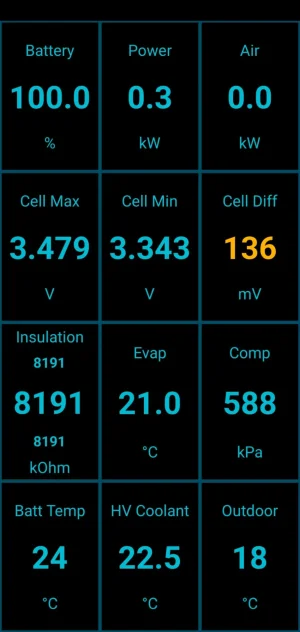
As promised, my read out of cell difference after a slow charge (probably averaging about 4.8kW) from ~25% to 100%

This time, the car decided to do no equalisation charge, which I was surprised about.

My eZS SoH percentage did not improve, as there was no balancing.
 

Attachments

  • a6665a78-1648-4f02-bfb1-c2eae5fd40c2.webp
    a6665a78-1648-4f02-bfb1-c2eae5fd40c2.webp
    58.6 KB · Views: 3
Interestingly, I did a full equalisation last night. Unfortunately mine didn't equalise either. I've realised I inadvertently did a short "boost" test charge of 2 minutes with a SOC at 17% then I stopped the charge. That killed the BMS programming for the equalisation charge. You mustn't interrupt any equalisation charge. If I had started the car again & perhaps driven a very short distance before setting off the equalisation it would have equalised ok. I now know that the car treated my test charge as an "interruption". It kills it! So will have to do it again in a few days. I did the test charge as Octopus asked me to disconnect my car & charger from the grid, then reconnect again. Several of my friends also had this request from Octopus.
 
My eZS SoH percentage did not improve, as there was no balancing.
Interestingly, I did a full equalisation last night. Unfortunately mine didn't equalise either.
Isn’t it a bit concerning that the very procedure to increase battery longevity can have the opposite effect?

Any advice on how an EV ‘noob’ with no diagnostic tools is going to verify that the ‘proper equalisation charge’ has completed correctly?
 
Isn’t it a bit concerning that the very procedure to increase battery longevity can have the opposite effect?

Any advice on how an EV ‘noob’ with no diagnostic tools is going to verify that the ‘proper equalisation charge’ has completed correctly?
Hi Mickey, no it's not concerning. A proper full equalisation to 100% doesn't harm the battery. Even NMC is fine with this, they are not fragile batteries. What harms the battery is charging it to 100% then leaving it standing for long periods at that high charge state. Not doing regular full equalisations is much more harmful.

Anyone can check their equalisation process whist it's going on just by watching the amount of power going into their car battery using their wall box charger app. Just make sure that any smart charging is switched off before starting the charge. It's easy.
 
Charging to 100% isn’t the issue, I’m more concerned about the resulting 136mV difference after @doubledroz ’s failed calibration?

I don’t know what level of imbalance @doubledroz ‘s cells were before but it looks like they are way worse now?

Looking directly at cell voltages may prove more reliable than interpreting wall box logs?
 
Charging to 100% isn’t the issue, I’m more concerned about the resulting 136mV difference after @doubledroz ’s failed calibration?

I don’t know what level of imbalance @doubledroz ‘s cells were before but it looks like they are way worse now?

Looking directly at cell voltages may prove more reliable than interpreting wall box logs?
Mickey, you are over complicating this. doubledroz has already stated he has been unable to carry out an equalisation charge on his 3yr old ZS with an LFP battery pack. So this is a case in point where not doing an equalisation for whatever reason causes premature battery degradation. His SOH is 89%. He may recover some of that by repeatedly equalising but it depends how far each battery cell has degraded. Remember degradation at scale is permenant & each cell degrades at a different rate if the battery pack is not equalised.

Why would looking at individual battery cells voltages prove more reliable than watching the equalisation process in action? That's not very convenient. You don't need to look at wall box logs. You only need to see the voltage stepping down once at 100% & then if you want monitor the timeframe over which it equalises. I tend to watch this in real time. That's a great guide to how unbalanced the battery is. You can easily see how much extra equalising energy is being put into the battery. Noobs won't be very interested in cell voltages or usually know how to do it. I check mine as you do but it's not required in order to see what's going on. By all means check the voltages after the equalisation has finished as that can in part be a guide as to how much degradation is going on. None of this is complicated so why make it so.
 
You only need to see the voltage stepping down once at 100% & then if you want monitor the timeframe over which it equalises.
You mean current reduction?
I tend to watch this in real time. That's a great guide to how unbalanced the battery is. You can easily see how much extra equalising energy is being put into the battery.
Is the ZS using active balancing, passive methods usually doesn’t require extra energy?
Noobs won't be very interested in cell voltages or usually know how to do it. I check mine as you do but it's not required in order to see what's going on.
Out of curiosity, what was your min/max cell voltage after the failed calibration
By all means check the voltages after the equalisation has finished as that can in part be a guide as to how much degradation is going on. None of this is complicated so why make it so.
After a successful balancing session all cells should be at the same level (within a few millivolts anyway), however that’s no indication of the battery health, I.e. this can be achieved even with degraded cells.
 
For NMC yes, but with LiFePO4 cells you'll often see bigger differences at the upper knee of the SOC-voltage curve.
Afaik the flat LFP charge/discharge curves are challenging for the BMS when it comes to accurate measure SoC, however I wouldn’t have thought that this also affects top balancing?
 
In the last 18 months after going EV, I've devoured the internet on all things electric and read through all these great posts daily.

It's my new hobby.

It's just occurred to me (and made me laugh out loud!) that if I mentioned these subjects in the same detail to my mates, I'd probably get a slap :ROFLMAO:
 
Afaik the flat LFP charge/discharge curves are challenging for the BMS when it comes to accurate measure SoC, however I wouldn’t have thought that this also affects top balancing?
The BMS will use coulomb counting, rather than voltage for SOC calculation.

Because the upper knee on LFP cells is so steep the delta will be quite large (i.e. compared to NMC cells) when cell voltages are over 3.45V per cell, despite them being relatively well balanced.

Graph below is no-load voltage vs. SoC for typical LiFePO4 cells

SOC.PNG
 
Last edited:
In the last 18 months after going EV, I've devoured the internet on all things electric and read through all these great posts daily.

It's my new hobby.

It's just occurred to me (and made me laugh out loud!) that if I mentioned these subjects in the same detail to my mates, I'd probably get a slap :ROFLMAO:
You're not wrong! 😂
 
Because the upper knee is so steep the delta will be quite large (i.e. compared to NMC cells) when cell voltages are over 3.45V per cell, despite them being relatively well balanced.
Balancing (at least the way I understand it) commences when charging is completed (I.e. when the first cell reaches the cut-off voltage).

Passive balancing:
The BMS then determines the lowest cell voltage and turns on the blalancing resistors of every cell above that level and thus ‘bleeds off’ excessive capacity (turning it into heat) until they are all equal.

Active balancing:
Excess capacity of the highest level cells is used to bring up the lower levels cells until an equilibrium is reached.

Balancing therefore works with cell voltages (not SoC) which can be determined quite accurately, despite them being in the upper knee?

None of these methods require additional energy from the EVSE therefore I’m puzzled why there seems to be a continuous (albeit reduced) power draw after charging is completed.

Both methods would also suggest that when balancing is completed, all cells would end up at a lower level than cut off voltage.

Anyone care to explain where I’m going wrong?
 
Support us by becoming a Premium Member

Latest MG EVs video

MG4 EV Refresh + NEW MG4 EV Urban - UK arrival dates, prices, specs (2026)
Subscribe to our YouTube channel
Back
Top Bottom