Still gonna carry on using me Granny Charger. But since the incident with mine I will be more vigilant. I've fitted an EV rated Socket and I'm back to using my MG supplied Granny Charger, which seems fine, but not ideal coz of the 4m cable. Will get another one with a 5/6m cable, but make absolutely sure it's a 10 amp one, and a decent make. 🙂👍
 
Still gonna carry on using me Granny Charger. But since the incident with mine I will be more vigilant. I've fitted an EV rated Socket and I'm back to using my MG supplied Granny Charger, which seems fine, but not ideal coz of the 4m cable. Will get another one with a 5/6m cable, but make absolutely sure it's a 10 amp one, and a decent make. 🙂👍

I use a 10m Masterplug one. Has 10a, 8a and 6a settings. (They also sell upto 15m length)

Got mine from Amazon - https://www.amazon.co.uk/dp/B0DMFMGC89
Was £100 for the 10m at the time on sale.
 
However there must be a flaw in British plug design, if the fuse is getting hot enough to melt and burn plastic, surely it should blow before that happens.
The two are largely unrelated. A fuse is designed to blow when the current flowing through it exceeds a predefined current limit for a given time. At that point the fuse wire will be in excess of 200°C. Overheating of a plug, to the point of melting would not trigger a fuse to blow.

Or is it bad fuse contact, so the outside of the fuse gets hot but the fuse wire doesn't?
(y)

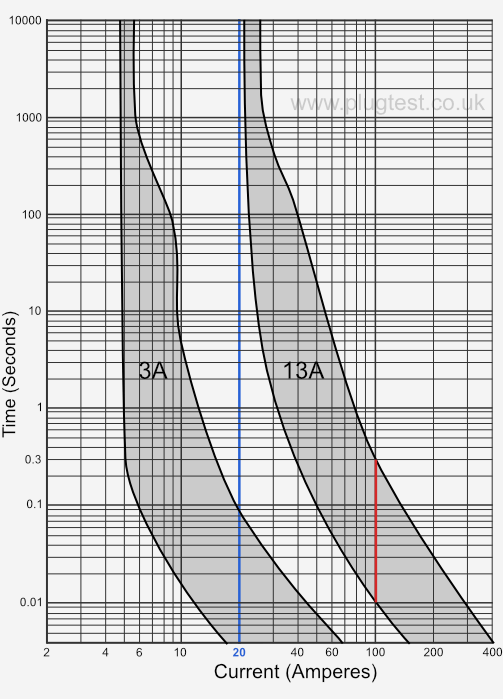
Furthermore, a 13A fuse won't blow if, say 16A, is passed through it. It will happily continue working with a current of 20A passing thought it, with ambient temp of 25°C, until the cows come home. It will blow when about 22A is passed through it for more than 30 minutes. At 30A it will blow between 1s and about 5 minutes... here is the relevant graph of current vs. time to blow characteristics of a BS1363 fuse.

bs1362-fuse-characteristics.png


They all come fitted with 13 Amp protection fuses as standard normally.
Should they ? - No I don’t think they should to be perfectly honest, but that’s another debate for another time.
They are purchased and it’s left to the individual, then to fit them to what ever appliance to what they want basically.
If you purchased the cheapest plug you could find and installed it onto a table lamp with a 40Watt lamp installed, it would relatively okay to use.
The fact it has a 13 Amp fuse that is WAY to overrated is another story.
If the user is wiring up their own plug they should put the correct rated fuse for the WIRE attached to it. A 40W table lamp will not have 13A rated wire attached to it, so it is imperative that the user changes the fuse according to what is connected to it. Fuses primarily protect the wires that are connected to them.

How long ago was the BS standard set for these items ?.
Has it kept in touch with high loads, put on these plugs over longer time scales ?.
Maybe its time they were reviewed ?.
BS 1363-2 standard for EV chargers was introduced in 2016, IIRC.

Oh ……. While your at it, consider placing a MAX upper limit of 8 Amps on the Granny units produced as well 👍.
(y) As I have been saying for a while on here.
 
Last edited by a moderator:
Still gonna carry on using me Granny Charger. But since the incident with mine I will be more vigilant. I've fitted an EV rated Socket and I'm back to using my MG supplied Granny Charger, which seems fine, but not ideal coz of the 4m cable. Will get another one with a 5/6m cable, but make absolutely sure it's a 10 amp one, and a decent make. 🙂👍
I'm not going to relate on here my particular granny charger set-up (and that is sufficient info for those with knowledge to suspect/know what I'm probably doing), but I'm OK with it for various technical and practical reasons.

However, what I would say to anyone using a granny charger set-up with a BS1363-2-compliant socket is to consider replacing that socket every 3 to 5 years, especially if you've been using it 4 or 5 times a week. Inspect it (or get it inspected) regularly anyway.
 
It seems to me that BS1363-2 (BS1363/A for the plug) his only half the story.

There seems to be another standard of BS1363-2 EV.

I certainly plan now to replace the plugs and sockets on a regular basis. The cost is relatively low compared to the other possible costs, such as putting in a 7kW unit into a house which I may only be in for a couple more months, or going to public chargers.

I keep trying to get a commando plug fitted, but my electrician keeps making different excuses, which is a pain.
 
The problem for commando (16A) plugs and sockets is that they are not shuttered, so interpreted by some installers / electricians as not suitable for use in domestic environments. You'll need an interlocked switch / socket for the commando. This won't allow the socket to be turned on unless there is a plug inserted, and then is regarded as safe.... some electricians will still have a view on whether they'll fit it.
 
FWIW I used the MG supplied EVSE for the first 2 years of ownership without any issues. The plug was never more than mildly warm and none of the various sockets used showed any signs heating. I mostly used it in the daytime soaking up the excess solar so was on for 6 or so hours, 4 hours overnight on GO but on a couple of occasions > 20 hours and one around 28 hours.
 
I would also suggest setting the charge rate in the AC charge settings of the car to 8 amp if you are charging for a prolonged period so it does not demand the maximum from the supply of the granny unit.
 
The plug was never more than mildly warm and none of the various sockets used showed any signs heating.
I got complacent. For the first (approximately) three months, I checked very regularly and, like you, found that it never got more than slightly warm. I then sort of forgot about it and didn't bother for a while.

The next thing I knew, maybe six months later, was finding the mess at the top of this thread.

I've now got a little stockpile of /2 and /A plugs and sockets and will simply replace them every few months or as long as I live here.

I've also ordered a sensor probe, which will send an alert to my phone if the temperature gets high.

The economics of doing that are still very much in my favor compared to either getting a wall box or charging outside cheap hours.
 
Last edited:
I got complacent. For the first (approximately) three months, I checked very regularly and, like you, found that it never got more than slightly warm. I then sort of forgot about it and didn't bother for a while.

The next thing I knew, maybe three months later, was finding the mess at the top of this thread.

I've now got a little stockpile of /2 and /A plugs and sockets and will simply replace them every few months or as long as I live here.

I've also ordered a sensor probe, which will send an alert to my phone if the temperature gets high.

The economics of doing that are still very much in my favor compared to either getting a wall box or charging outside cheap hours.
What is interesting is others have had a similar problem with your VDL Charger from Amazon and after contacting the seller they have had a replacement sent out.

1773506524795.webp
 
Thank you, I will see what they say. I have cut off the offending plug and thrown it away, so I could understand if they weren't so nice about it, but nothing ventured nothing gained...
 
I've also ordered a sensor probe, which will send an alert to my phone if the temperature gets high.
Can you share what the sensor probe was @TimothyN, it may be a safeguard to others who don't have the 5 wire type input lead with a temperature sensing 13A plug.
 
The economics of doing that are still very much in my favor compared to either getting a wall box or charging outside cheap hours.

Yes, but I'd still not recommend charging at 13A anymore.

P = I^2 x R, so at 13A there is 69% more power dissipated at any given point of resistance than when you charge at 10A and a whopping 2.6 times the power than if you are charging at 8A.

As I keep saying BS1363 plugs and sockets, even EV rated ones are not rated for continual usage at 13A.
 
Yes, but I'd still not recommend charging at 13A anymore.

P = I^2 x R, so at 13A there is 69% more power dissipated at any given point of resistance than when you charge at 10A and a whopping 2.6 times the power than if you are charging at 8A.

As I keep saying BS1363 plugs and sockets, even EV rated ones are not rated for continual usage at 13A.
My current thinking is that if I can achieve what I need to achieve in 7 hours at 10 amps, then that is what I will do. Occasionally I need to do more, so I will then stick it up to 13 amps.

It all seems to be a matter of attrition. I think if I keep to that regime—which is very easily managed by my granny charger with just a couple of button presses to change from 13 to 10 and back again—and I regularly change the plug and socket, it would seem to me that it will probably be okay.

What I find most ironic is that the part that failed is actually part of the granny charger, and therefore should have been the one item in the chain which was properly rated.
 
Support us by becoming a Premium Member

Latest MG EVs video

MG4 EV Refresh + NEW MG4 EV Urban - UK arrival dates, prices, specs (2026)
Subscribe to our YouTube channel
Back
Top Bottom