So, even on an "EV only" tariff, you can still charge the car, then discharge it during the day to run your appliances?
Yes in principle.

I'm no expert, but you could probably draw a Max of 3.3kW from an S5.

You cannot 'back-feed' the power into the house unless you get a "sparks" to wire in the necessary interface. But you could use extension leads to power a few selected devices; fridge, TV, computer... up to (say) 2kW load.

I guess you need to factor in losses to see if you can stay ahead of the game; 10%?
 
I power "big ticket" items. Mostly the 3kW oil radiator I use to heat the conservatory I use as an office, which has no CH radiator, but also the oven, the washing machine, tumble drier and dishwasher (if I am going to use them by day, I mostly time them to run at night.) Obviously, I only use one at a time, so the load never exceeds 3kWh.

If the losses are 10% (I have no idea) that means I am paying 7.4p per kWh, as opposed to 26p, so I can live with that!!

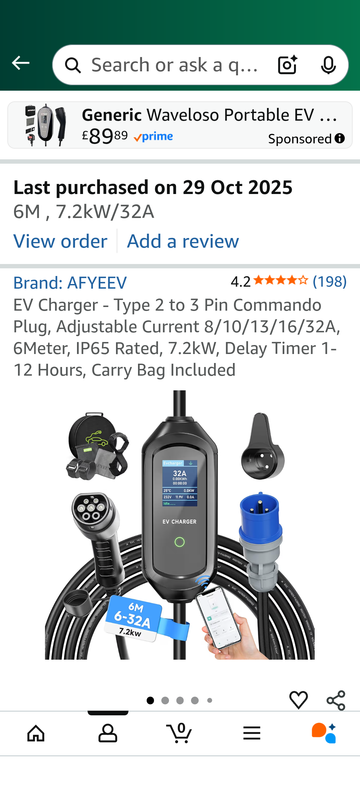
Rather than a fixed 7kW wallbox I bought a "portable" 7kW with 32a Commando plug (round industrial standard), then paid £250 for an electrician to install the corresponding socket in the front part of my garage to a spare consumer unit RCB.

It easily reaches under the locked garage door to my ZS LR, saved £500 over the fixed option and allows me to carry the charger to a second home in France.

Screenshot-20251222-110812.png
Oooh....splendid idea, I had no inkling that such a thing is possible. I'll look right into it...

It also has the benefit of being removable and takeable to the next place...
 
Oooh....splendid idea, I had no inkling that such a thing is possible. I'll look right into it...

It also has the benefit of being removable and takeable to the next place...
(y). A few of us have gone down that route...
e.g. here
and
 
Hi all, appreciate your messages. I've just done some basic calculations regarding costs etc and they show that by switching to an EV tariff with the higher peak unit costs would only save me around £8-10 per month compared to my existing tariff, whilst charging 50% once a week. If that's true that would equate to an electricity saving of just £120 per year. Obviously I'm going to save around £400/y on petrol but the initial £1000+ charger outlay would take 10+ years to recoup. My sparky mate is very much against me using a charger that simple plugs into a 13amp socket as he's personally responding to and fixed numerous sockets/plugs that have melted/burnt due to the constant 13amps going through it. Food for thought?
 
My sparky mate is very much against me using a charger that simple plugs into a 13amp socket as he's personally responding to and fixed numerous sockets/plugs that have melted/burnt due to the constant 13amps going through it. Food for thought?

All caused by EVs? or other stuff?
Almost certainly didn't do there homework and didn't have the correct socket, etc. 🤷‍♂️
 
Obviously I'm going to save around £400/y on petrol but the initial £1000+ charger outlay would take 10+ years to recoup.
Agree.
My sparky mate is very much against me using a charger that simple plugs into a 13amp socket as he's personally responding to and fixed numerous sockets/plugs that have melted/burnt due to the constant 13amps going through it. Food for thought?
For continual use, you should have a BS1363-2 type EV socket installed off a dedicated radial final and then running a maximum of 10A for charging. Even then, there have been issues, especially with poorly connected 13A fuses in the granny chargers plug... e.g. like in this thread below... Hence the commando socket being a good half-way house for low-usage such as yours. Even better if you have a sparky mate who can install a 32A commando socket on an external wall for you :)

 
All caused by EVs? or other stuff?
Almost certainly didn't do there homework and didn't have the correct socket, etc. 🤷‍♂️
Just from using EV chargers

So, a dedicated properly installed 7kW charger seems to be the best/safest option, if the numerous opinions on here are to go by, and certainly the most convenient, that just leaves the EV tariffs. If, for example, I stuck with my existing tariff at 25p/kWh using a 7kW charger, a 5h charge once a fortnight (at any time of day), roughly 55% battery increase, would cost me £8.75. In comparison the IOG cheap rate of 7p/kWh during the night for 5h would cost £2.45, a saving of £6.30/charge/fortnight, a yearly saving of £163.80. Whether that saving will cover my increased bills for everything else running during the day who knows? The only things we'd be able to run specifically at those times would be the washing machine and dishwasher, unless my wife fancies cooking us oven meals in the early hours.
 
I think you would need to be charging the car more and moving load from the day to the night time to make it worthwhile switching to a day/night option.

I think you need buy in from the wife to make it work (not the cooking bit). And kids if you have them lol.

There is no rush to be honest. Get the charger installed, get a smart meter installed and start working the numbers out. I would only switch once you know it works for you. Costly mistake if you get it wrong. Doing nothing for now just maintains the status quo.
 
Hi all, hope life's treating you well.
I've taken the plunge on my first EV and have gone for the MGS5 EV Trophy. I hope it lives up to my first impression as I was blown away with how good it looks, how comfortable it feels and the price for such a great car (heavily discounted). I now have to organise a charger and switch over to an EV tariff, more than likely the Octopus Intelligent Go, but I was wondering what other things an EV newbie should buy/install/arrange and perhaps general advice on running/maintaining an MG EV. Any advice greatly appreciated.
Cheers.
I'm on my 2nd EV (MGS5, MG4 previously)
Using Intelligent Octopus Go, giving 6 hours (11.30pm to 5.30am) to charge the car with the excellent Ohme Home Pro 7kW EV Charger, we also run any other high usage utilities during the cheap 6 hours, like washing machine and dishwasher etc, all at cheap rate of 7p per kWh, we also have (DIY) solar and large 45kWh lead acid storage capacity (we are all electric with a ground source heat pump) so I charge the battery bank every night for 7p per kWh too, summer and winter then when there's good solar, pay back to the grid @15p per kWh, that makes great economic sense.
When I'm (occasionally) traveling I too use Octopus Electroverse, but where possible I prefer Tesla Superchargers, not all are available to non Tesla vehicles, but tend to be a fair bit less expensive than Electroverse and much cheaper than some of the motorway and forecourt chargers.
A little bit of research helps in planning your route to get the best cost vs time and additional distance needed to travel for cheaper charging costs, sometimes it's just easier to pay the higher charge costs, I'm retired so time is less of a constraint.
 
...When I'm (occasionally) traveling I too use Octopus Electroverse...
A little bit of research helps in planning your route...
My first 'long' trip is coming up soon. I want to use Electroverse such that I can stop after (say) 2hrs for a coffee & charge break. I expected that putting in a waypoint would allow me to do that, but can't at the monument see how that's done. (I get the stop, but not a suggestion for charging).

Any advice?
 
Another shout for ABRP. You can add the Electroverse card in the settings and tell it to use compabilte charging sites. Let it route you a plan and then pop the first stop into Waze / Google Maps is my advice.

*Not actually had to do this yet - but this is my plan if ever do more than the range :P
 
I expected that putting in a waypoint would allow me to do that

Putting the waypoint in to what? The Electroverse app, Google Maps, Waze?

I tend to use Zapmap for finding the location of chargers along my route then the Electroverse app to see which are accessible via that app.

But, I, like others who've posted here, will always try to find Tesla Open Superchargers for the cost savings they offer.

Personally, although I initially downloaded and installed ABRP, for some reason (most likely user error) I never found it really useful! I still have it installed on my phone but I don't think I've even opened it for quite some time.
 
Whether that saving will cover my increased bills for everything else running during the day who knows?
Presumably, even without a smart meter, you will have at least quarterly bills from over the last year to work out a reasonable estimate of your consumption and proportion that accordingly to work out whether the increased day rate will be more or less than your £160 charging difference?

The only things we'd be able to run specifically at those times would be the washing machine and dishwasher, unless my wife fancies cooking us oven meals in the early hours
IME, even that depends on other factors, not just £££. We tried the dishwasher at night, but a) the pipe noises disturbed us and b) without an auto-opening door on our dishwasher, found things didn't dry as well as they did when we aired it before going to bed. As for the washing machine, I like to air or tumble clothes just after they've washed. And, although I could set a delayed spin on our machine I can't be ar$$ed with all that faffing just to save a few pence.
 
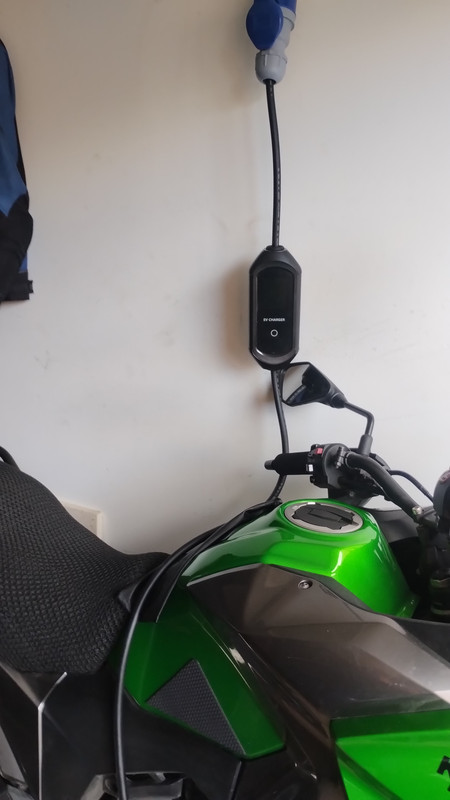
Hopefully you have a spare slot in your consumer unit, as said I had a sparky install a dedicated feed to my garage (see pic)

Looks good - presumably not an e-motorbike though?

As for the consumer unit... Yes, that is a good solution if you have a modern one with individual RCBO's or a dual pole type A RCD.

I would not recommend wiring an EV charger downstream of your main RCD, if it is an older Type-AC RCD. The reason being is that the DC leakage on an EV charger can blind a Type-AC to a genuine fault and it may not trip correctly should a fault occur on your house circuits.

Regulation 722.531.3.101 of BS 7671:2018+A2:2022 said:
... that unless the circuit is supplied using the protective measure of electrical separation, each charging point incorporating a socket-outlet or vehicle connector complying with the BS EN 62196 series is to be protected individually by an RCD of Type A, Type F or Type B and having a rated residual operating current not exceeding 30 mA. The RCD is also required to disconnect all live conductors.
 
I think you would need to be charging the car more and moving load from the day to the night time to make it worthwhile switching to a day/night option.

I think you need buy in from the wife to make it work (not the cooking bit). And kids if you have them lol.

There is no rush to be honest. Get the charger installed, get a smart meter installed and start working the numbers out. I would only switch once you know it works for you. Costly mistake if you get it wrong. Doing nothing for now just maintains the status quo.
wise words, thanks
 
We tried the dishwasher at night, but a) the pipe noises disturbed us and b) without an auto-opening door on our dishwasher, found things didn't dry as well as they did when we aired it before going to bed.

Turned out we had a timer on our dishwasher so could time it to be ready when we got up.

Noise doesn't seem to be a problem as we are at the opposite end of the house.
 
All my white goods are quiet/distant enough to sleep through.

I find that if I set the washing machine to run at midnight, I can rely on my bladder to tell me when it's time to move clothes to the drier.

One small advantage of advancing years.
 
Hopefully you have a spare slot in your consumer unit, as said I had a sparky install a dedicated feed to my garage
My sparky is going to run some tests, but thinks that he can use the existing wiring to the 13a plug in the garage to put in a 32a Commando, as the circuit is 32a to start with, which will make the whole thing much cheaper...
 
Support us by becoming a Premium Member

Latest MG EVs video

MGS6 deep dive + MG2 rumours, MGS9 PHEV preview and Cyber X tease
Subscribe to our YouTube channel
Back
Top Bottom