
fx860e
Standard Member
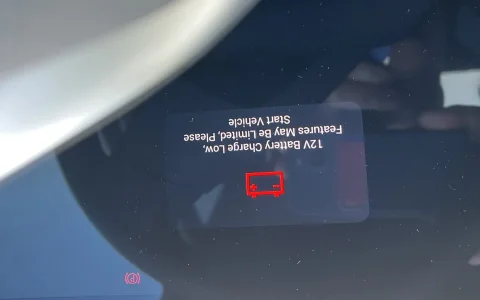
A couple of days ago I found that when I turned the ignition on, I received a message on the driver’s screen informing me that the 12V battery was low and some things might not work as expected. I needed to go out at the time so I couldn’t check the voltage, but everything seemed to work as it should anyway.
Yesterday I put my clamp multi-meter around the positive lead of the 12V battery and monitored the amperage to see what was going on.
On turning off the Heating and disconnecting the Wi-Fi signal I pressed the start button once and locked the doors.
UPDATE.. I received the message again so i took my multi-meter and found that the voltage was 11.95 volts.....Hardly low, i was expecting 10 or below.

I initially saw a charge going from the main battery to the 12V battery at around 60A.
When the voltage reached 14.4V it tapered off and got to around 0.5A, then it settled at 14.20V.
I then switched off the ignition, locked the doors and put the key fob indoors as I noticed that when it was near the car it caused it to wake up and draw around 10A.
After locking the doors at a distance, the car drew around 10A for a couple of minutes, and then it would tapper off withing 5 minutes and would settle around 250 mA to 500mA.
It never went below that over the next few hours that I monitored it, but sometimes for no reason it would jump to 10-11A and then start to settle down again withing 5-10 minutes, though it never went below 250 mA to 500 mA.
I know that a quarter to half an amp doesn’t sound much, but over a few days it would build up and may explain why I received the low voltage warning message.
I haven’t had the chance to see what happens when the car enters the sleep mode. I’m guessing it could be why my car sometimes won’t charge overnight, and my Scottish Power app informs me that the car was disconnected and they couldn’t start a charge. (If the cars been standing for quite a few hours, even though the charging cables were attached.) I can only start the charge by sitting in the car and turning the ignition on and off.
I also notice sometimes the infotainment screen and driver's screen comes on immediately as soon as I push the power button, and sometimes it takes a while as it has to boot.
Thought I’d share my findings.
Yesterday I put my clamp multi-meter around the positive lead of the 12V battery and monitored the amperage to see what was going on.
On turning off the Heating and disconnecting the Wi-Fi signal I pressed the start button once and locked the doors.
UPDATE.. I received the message again so i took my multi-meter and found that the voltage was 11.95 volts.....Hardly low, i was expecting 10 or below.
I initially saw a charge going from the main battery to the 12V battery at around 60A.
When the voltage reached 14.4V it tapered off and got to around 0.5A, then it settled at 14.20V.
I then switched off the ignition, locked the doors and put the key fob indoors as I noticed that when it was near the car it caused it to wake up and draw around 10A.
After locking the doors at a distance, the car drew around 10A for a couple of minutes, and then it would tapper off withing 5 minutes and would settle around 250 mA to 500mA.
It never went below that over the next few hours that I monitored it, but sometimes for no reason it would jump to 10-11A and then start to settle down again withing 5-10 minutes, though it never went below 250 mA to 500 mA.
I know that a quarter to half an amp doesn’t sound much, but over a few days it would build up and may explain why I received the low voltage warning message.
I haven’t had the chance to see what happens when the car enters the sleep mode. I’m guessing it could be why my car sometimes won’t charge overnight, and my Scottish Power app informs me that the car was disconnected and they couldn’t start a charge. (If the cars been standing for quite a few hours, even though the charging cables were attached.) I can only start the charge by sitting in the car and turning the ignition on and off.
I also notice sometimes the infotainment screen and driver's screen comes on immediately as soon as I push the power button, and sometimes it takes a while as it has to boot.
Thought I’d share my findings.
Attachments
Last edited:



