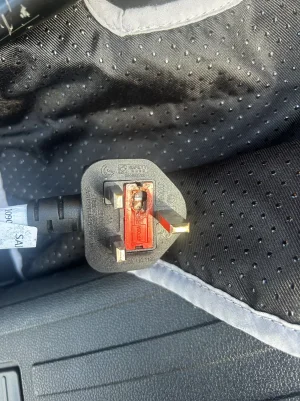
Can you share what the sensor probe was @TimothyN, it may be a safeguard to others who don't have the 5 wire type input lead with a temperature sensing 13A plug.
https://amzn.eu/d/09ClnOHX

But I haven't received it yet, so I have no idea whether it works.
 
As an Amazon Associate we earn from qualifying purchases.
Thank you, I will see what they say. I have cut off the offending plug and thrown it away, so I could understand if they weren't so nice about it, but nothing ventured nothing gained...
If you have chopped off the three pin plug, would this not be a good opportunity to upgrade to a 16amp socket instead ?.
 
If you have chopped off the three pin plug, would this not be a good opportunity to upgrade to a 16amp socket instead ?.
Oh I wish! I live in a rented house and I have to choose between a very limited number of contractors. The one I have chosen for this has so far taken nearly three months not to do it.
 
Oh I wish! I live in a rented house and I have to choose between a very limited number of contractors. The one I have chosen for this has so far taken nearly three months not to do it.
How frustrating is that !.
That would be the best way to go I think.
This type of arrangement maybe ?.

IMG_4130.webp


IMG_4131.webp
 
What is interesting is others have had a similar problem with your VDL Charger from Amazon and after contacting the seller they have had a replacement sent out.
I have written to them but, thinking about it, do I really want a replacement?

The weak point was the plug, so the first thing I would do would be to cut it off and put on a heavy duty one, then I have two units with replacement plugs, one house and one car. I suppose I have it in reserve, but...
 
Oh I wish! I live in a rented house and I have to choose between a very limited number of contractors. The one I have chosen for this has so far taken nearly three months not to do it.
The renters grant for 75% of the cost of a wallbox has been extended until 2027 and maxes out at £500 from April.
 
https://amzn.eu/d/09ClnOHX

But I haven't received it yet, so I have no idea whether it works.
Well, it seems to work. I have had the sensor on an oil radiator all afternoon and set it to record once an hour, which worked fine. You can either download the history and look at graphs, or just get it to show the maximum temperature reached.

So I've now wiped its memory and will leave the probe sitting on the plug, held in place by BluTack. It's too big to fit between the plug and socket, sadly.
 
As an Amazon Associate we earn from qualifying purchases.
I ran my EVSE through a Tapo, to record usage not to do the switching. It has overheat protection but never reported anything in the almost 2 years of using it.
 
VDL seem to be taking the whole thing very seriously, including taking the whole batch off the shelf. They have offered replacement or refund, but I haven't accepted either (so far).

I have made the point that they claim that it runs at 13A continuous and it was their component that burned. At the very start they tried to blame incorrect seating of the plug in the socket but quickly retreated when told the facts of life.

I have told them that I will decide on whether to talk to Trading Standards or Kent Fire and Rescue Service when I hear their full response.
 
I've seen this countless times in 30 years of sparking, with appliances like washing machines, tumble dryers and dishwashers.

Also other appliances that don't plug in, like cookers and showers.

There are four points of potential failure with a plug/ socket arrangement:

1. The fuse contacts.
2. The pin terminals in a wired plug.
3. Poor quality sockets, or older sockets, where the contact between socket terminal and plug pin is poor.
4. Loose connections at the back of the socket.

Electrical overheating is all about high resistance. You want the low resistance, as loose joints are high resistance and create heat. And the more current you put through that loose joints, the more heat is created.

Whether it be a moulded plug or a wired one, I always take out the fuse and pinch the fuse holder contacts together, then when I put the fuse back in, the contact between them is much more assured.

The other issue with wired plugs is of course the connections to the pins, which is not in my experience an issue with the moulded ones.
 
Your "regular" outlets are 10A. But I guess the granny chargers are rated under.

Ours are also rated under. I've never seen mine run at anywhere near 13A.

Talking about quality accessories, I did test a cheap brand (CED) that I bought when we moved in to this house and I fitted them in the garage for the washing machine and tumble dryer and that was in 1999. I thought I'd test them out and if they were OK I'd buy a few more. They are still going strong!

We are on our 3rd washing machine and our 3rd tumble dryer since then.
Those cheap single sockets were 79p each including the dreaded!

But ordinarily, I'd recommend a quality recognised brand of plug and socket.
 
But ordinarily, I'd recommend a quality recognised brand of plug and socket.
I agree but I do wonder how many brands are no more than the name slapped on a cheaply made product with an inflated price. Does anyone know if MK is still a brand to be trusted?

Incidentally I looked for any regulations relating to output power but only came up with an AI generated description that implied although some were 13amp most were derated to 10amp to avoid overheating.
 
The protection fuse is intended to be the weakest point in the circuit, for safety reasons of course.
But in actual fact, you rarely see the fuse itself actually fail !.
I consider that the two thin clamping points that that retain the 13 Amp fuse inside the plug, to be the weakest point.
The three main contact posts of the plug are pretty substantial, but the fuse carrier clamping points themselves are pretty thin and therefore vulnerable.
The load passes through the live post, up through the fuse ( held by the thin clamping points ) then leaves via passing through the fuse itself and then onto the Granny unit.
Over repeated use and lengthy charging sessions, heat builds up around the area of the live pin itself and has to pass through those thin fuse retaining clamps.
Heat weakens / fatigues the material of the clamps and its ability to apply the same level of clamping force onto the fuse, and naturally it becomes weak and then compromised.
When this process commences, it’s only a matter of time before burning occurs to the casing of the three pin plug body.
Very rarely is this picked up by the owner, unless the plug is removed periodically from the outlet.
We are dealing with constant high load / demands over long periods of time.
It’s a similar situation on other high load appliances like microwaves / fast boil kettles and irons of course.
However, these items are only intended to be used for much shorter periods of time.
As battery packs get larger, then they need to be changed for longer periods of time of course.
This places a much higher strain on the electrical system used to provide the energy to the charger in the car.
Just to be clear here, so am not bashing owners who use Granny units.
This situation is not just isolated to the use of Granny units, although charging large packs over greater periods of time, will place a LOT strain on that unit without a doubt.
Wall boxes are better equipped to deal with the higher loads, but can also be vulnerable to the problems caused by heat build up equally.
There is enough evidence to support wall box overheating/ failure problems.
Purely speaking for myself here, I consider that if you intend to charge using a Granny unit regularly over longer period of time, you have to be super vigilant and do not become complacent with your regular safety checks.
If you are a low user case, or have a smaller battery pack, or a PHEV owner, then these Granny units are going to be mainly okay fundamentally.
If you are a higher user case and have a larger pack, then of course your risk of failure is increased massively.
Many manufacturers do not supply Granny units with their cars anymore, stating that the demand has fallen away due to the length of time they take to charge the car.
Although this is true, I can’t help but think there is other reasons why they are not encouraging their use anymore, if you get my drift.
I absolutely get your drift. We bought our ZS EV just before 2020 lockdown. It came with the 3 pin granny unit. We bought the other type so we had a cable if needed to charge away from the house. We are now 3 years into our second granny charger having had the first one burnt out. Now the second one has started to do the same. Our electrician has examined everything declared safe so it must be the granny charger causing the issues. Seen the dealer today and they’re blaming it on using an ‘extension’ even though it’s plugged into an independent outside socket that’s wired directly into an independent fuse in the main fuse box. Dealer did say today that the granny units aren’t designed for everyday use which is contrary to what we were told on purchasing the vehicle. Maybe this is something they discovered in the last 6+ years. Needless to say we’re not best pleased and now will prob have the expense of installing the alternative charging unit.
I have ready it can be better to use a 10amp fuse but assume that means a change of charger too but don’t know enough about it to be sure.
Any hints/guidance would be gratefully received
 

Attachments

  • IMG_0854.webp
    IMG_0854.webp
    679.7 KB · Views: 3
Does anyone know if MK is still a brand to be trusted?
From my recent experience and numerous postings on sparky forums, I'd say it's no longer the go-to brand for quality products.

Talking about quality accessories, I did test a cheap brand (CED) that I bought when we moved in to this house and I fitted them in the garage for the washing machine and tumble dryer and that was in 1999. I thought I'd test them out and if they were OK I'd buy a few more. They are still going strong!
Interesting - I recently fitted a CED Axiom CU for EV charging distribution and was impressed how well it was made - it was far from the cheapest though.

Incidentally I looked for any regulations relating to output power but only came up with an AI generated description that implied although some were 13amp most were derated to 10amp to avoid overheating.
(y) 10A is the maximum recommended continuous draw for BS1363 plugs/sockets, rather than mandatory. IIRC tests should prove max temp of 50C after 4h with no further rise thereafter for compliance. But that doesn't take into account degradation due to wear or tarnishing or bad installation.

I think the OP has proved that 13A continuous isn't a good idea!
 
Support us by becoming a Premium Member

Latest MG EVs video

MG4 EV Refresh + NEW MG4 EV Urban - UK arrival dates, prices, specs (2026)
Subscribe to our YouTube channel
Back
Top Bottom