Battery balancing and calibration MG4 NMC

NerdBurger

Novice Member
Joined
Apr 22, 2026
Messages
4
Reaction score
0
Points
4
Location (town/city + country)
Coffs Harbour
Driving
MG4 (2022-2025)
I am new to EV ownership and have read the previous threads on these topics and other materials trying to get an understanding of when and how to balance (equalise) the battery as I plan on keeping the car until it turns into a home storage battery. I tried to get an answer from MG, but was told to read the manual, which is vague at best.
Am wondering if anyone has the nerdy knowledge to answer my questions?

I recently experimented to see if the car would balance at 70% charge limit and found that it did. Took about 15 mins and the infotainment screen showed "balancing".
At 60% charge my OBD read 13mV of delta, and after balancing at 70% it's been reading 10mV delta. (Delta being the difference between the lowest and highest cell voltage in the battery pack)
As I understand it, if the delta is <=20mV, then the battery is "balanced" enough or normal, and if >50mV then needs balancing, and if >100mV may be too far out to balance adequately with the onboard BMS.

1. Is it really necessary to equalise monthly if my delta is in the normal range? (I was going to just leave the battery to do it by itself at 60-80% charge at times)
2. Is it really necessary to equalise at 100% if my delta is below 40-50mV, or can I leave this until the delta starts to creep up?
3. Can I leave a calibration charge (Different to equalisation as I understand) until I think my range might be going lower?
4. Is the calibration charge for an NMC battery from <10% to 100% on slow charger?
 
Welcome.

MGEVs has a vast wealth of information on the on the NMC vattery usage in the MG4 and it sounds like youve been looking around already.
You've understood it all very well.
With NMC, MG would expect you to charge up to 80%, known as the health mode, and change the slider on the infotainment screen or iSmart app in charge mode to 90 or 100% for long journey mode.
MG advise in a roundabout way to not leave it charged to 100% for long periods but to charge and use asap, as it stresses the batteries more.
It will balance at any target level you set for the charge max selected as long as its AC charging.
Most people would let the battery go between 20 to 80% for normal charge routines.
Users also like to run it down to 10% or less every month or two and then charge fully to 100% in one go (Calibration charge). This will recalibrate the GOM (Guess-o-meter) and will probably increase the predicted range. I like to reset the accumulated journey trip computer at the start of every month as this has an effect too as it clears any charging habit and range issues during the month.
Some have used OBD to look like you have at the battery delta information. I just let mine perform an equalising change when possible rather than just terminating the charge.
You'll soon get to know it's habits and use them to your advantage.
 
1. Is it really necessary to equalise monthly if my delta is in the normal range? (I was going to just leave the battery to do it by itself at 60-80% charge at times)
Not usually, unless you are high mileage and DC fast charge a lot.

2. Is it really necessary to equalise at 100% if my delta is below 40-50mV, or can I leave this until the delta starts to creep up?
If the car really needs an equalisation, it will tell you.

Else normal charging to 80% SOC will take care of it, provided it's the car's BMS which stops the charge session and not the EVSE (or service controlling it) as that can cut the session before equalisation has started/completed.

Equalisation at SOCs between 70-100% works reasonably well with NMC because the SOC-charge voltage relationship in that range is quite linear (unlike LFP).

3. Can I leave a calibration charge (Different to equalisation as I understand) until I think my range might be going lower?
Yes, and for a lot of us it sort of happens naturally as a result of a longer drive and coming home with a depleted battery, so it can be a good opportunity to do it then.

4. Is the calibration charge for an NMC battery from <10% to 100% on slow charger?
Yes. The BMS needs to record the actual amount of energy discharged/charged between a very low and full state of charge, else it is prone to error in estimating actual useable battery capacity. It's not a deal breaker, just a handy thing to do very occasionally.
 
Not usually, unless you are high mileage and DC fast charge a lot.


If the car really needs an equalisation, it will tell you.

Else normal charging to 80% SOC will take care of it, provided it's the car's BMS which stops the charge session and not the EVSE (or service controlling it) as that can cut the session before equalisation has started/completed.

Equalisation at SOCs between 70-100% works reasonably well with NMC because the SOC-charge voltage relationship in that range is quite linear (unlike LFP).


Yes, and for a lot of us it sort of happens naturally as a result of a longer drive and coming home with a depleted battery, so it can be a good opportunity to do it then.


Yes. The BMS needs to record the actual amount of energy discharged/charged between a very low and full state of charge, else it is prone to error in estimating actual useable battery capacity. It's not a deal breaker, just a handy thing to do very occasionally.
On another note, Wattmatters, have been reading some of your other very helpful posts and was wondering with the info you can get with the home assistant programme, does it have to be running when you are charging, travelling etc to pick it up and log it all, or can this be done after the fact? Would be handy for the ATO tax deduction rules for charging costs.
 
One more point about the calibration charge (<10 - 100%) .. park up the car and leave it at <10% for an hour or two (if you can). This (apparently) lets the battery pack "settle" and leads to a more accurate calibration.

That's what I've been told anyway, so I try to do that when I can. Again it's not a dealbreaker, but every little helps. :)
 
On another note, Wattmatters, have been reading some of your other very helpful posts and was wondering with the info you can get with the home assistant programme, does it have to be running when you are charging, travelling etc to pick it up and log it all, or can this be done after the fact? Would be handy for the ATO tax deduction rules for charging costs.
What info do you need?

While driving the car is always sending data to the SAIC server, so that part is covered, e.g. odometer readings. That doesn't tell you what the km were for though (e.g. personal v work).

Screenshot 2026-04-24 at 8.10.34 pm.webp


For charging energy it would be better to use data from your charging source(s).
 
2. Is it really necessary to equalise at 100%
Just on this, I have a sensor set up in my Home Assistant which counts the days since my car was last at 100% SOC. MG4 Essence 64.

It's a tool I have to check it hasn't been too long. Usually it looks after itself without me needing to schedule it as I'll typically give the car a full charge before a long journey.

Here's what the chart looks like showing the growth and reset of that daily counter over the past two years:

Screenshot 2026-04-24 at 8.14.36 pm.webp


It's currently at 77 days and that will reset one day next week as I have a long drive planned and will be fully charging beforehand.
 
One more point about the calibration charge (<10 - 100%) .. park up the car and leave it at <10% for an hour or two (if you can). This (apparently) lets the battery pack "settle" and leads to a more accurate calibration.

That's what I've been told anyway, so I try to do that when I can. Again it's not a dealbreaker, but every little helps. :)
that's right, there's a bigger voltage sag when under load at lower states of charge which would give the bms too low a reading below 10%.

this is again third party knowledge, the specific battery and bms should really come with a manual of their own 😅
 
What info do you need?

While driving the car is always sending data to the SAIC server, so that part is covered, e.g. odometer readings. That doesn't tell you what the km were for though (e.g. personal v work).

View attachment 45952

For charging energy it would be better to use data from your charging source(s).
Yes, it is the charging data required. Home % and fast charger %. I think tesla's clock these stats but did not think MG4's did. Saw that one of your home assistant charts showed these stats (may have been your partner I think).
Looks like you can track some great info with that programme. Though I'm not terribly tech savvy and will probably be a long learning curve to use it for me.
Thanks again!
 
Yes, it is the charging data required.
In that case you would be better to put a power/energy monitor on your charge station circuit if it doesn't have something already built in. It's the energy put through a charge station you are paying for, not what ends up in the car's drive battery.

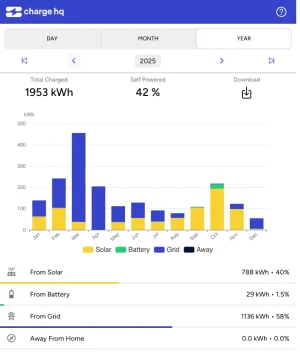
Another option is to use ChargeHQ.

It provides detailed reports on all home charging sessions. But you'd need their paid service to download the data. This is probably sufficient though.

Screenshot 2026-04-25 at 9.05.57 am.webp


screenshot-2026-04-25-at-9-06-14%E2%80%AFam-webp.46013

Your charge station would need to be compatible, anything with OCPP 1.6 or higher (open charge point protocol) likely will be.

The subscription for the service should also be claimable, not sure current price, it was $7/month when I last looked. But if just doing scheduled charging and being able to view the data is all you need, then it's free,

I used to use ChargeHQ for controlling my ZJBeny charge station but stopped the paid option a few months back as we now have the Sigenergy DC charging module so I rarely use the AC charge station any more. It's still controllable with ChargeHQ on their free service and I can do schedules or manual control but no charge from excess solar or downloadable reporting. The still provide the data on screen though in the app.

It can record away charging sessions for compatible vehicles (e.g. Tesla) but not for the MG4. You'd need to keep your own record of fast charge sessions, which isn't hard as most charge networks provide that as part of their app. I just put my DC fast charge sessions in a spreadsheet.
 

Attachments

  • Screenshot 2026-04-25 at 9.06.14 am.webp
    Screenshot 2026-04-25 at 9.06.14 am.webp
    22.6 KB · Views: 50

Are you enjoying your MG4?

  • Yes

    Votes: 1,095 77.7%
  • I'm in the middle

    Votes: 212 15.0%
  • No

    Votes: 103 7.3%
Support us by becoming a Premium Member

Latest MG EVs video

MG4 EV Refresh + NEW MG4 EV Urban - UK arrival dates, prices, specs (2026)
Subscribe to our YouTube channel
Back
Top Bottom