Interesting thread. Australia has far different conditions but I'll provide you with my example which I am very happy with. We purchased an acreage property last August. It had a 20 year old 8 x 175 watt panel system with dirty panels producing about 900 W of output on a sunny day at mid-day.

I had put 2 systems on my previous house. The first a 2kW system in 2013 & then a 6.6 kW system with 5 kW inverter in 2024. The later system cost less than the first. No batteries though but my energy bills were negligible. MG4 & ZJBeny 7kW wall charger installed in Sept 23.

The new property has some large sheds. I got the same company that installed my 2nd system to install the new system & battery.

I have 20 x JA Solar LB series 440 W bi-facial panels in 3 strings, 7 west facing, 7 East facing & 6 North facing at approx 20 degrees, good for this latitude. Total rated output 8.8 kW.

Fox ESS 10 kW hybrid inverter. Fox ESS 18.64 kWh modular LFP battery with 100% useable capacity.

The installers removed the old system which I cleaned up & is now in my shed awaiting disposal to someone who wants a small system cheap.

I wanted the ability to use the battery in the event of a power cut but as the house is 20 metres from the shed plus some dumb regulations it was not possible at reasonable cost.

Installation date 24 November 2025. Total cost after government subsidies $11,797.00.

Results to date

I
have not imported any grid power at all.

Maximum solar production in late December at around midday was 10.1 kW from my 8.8 kW of panels. This I presume is partly due to the bi-facial process.

Lowest battery charge status has been 25% after running the air conditioning for most of the day & night in January plus cooking etc. Average low charge status in the morning is 70%. Order of use is solar first, then battery & grid last.

The battery has recharged to 100% every day so far even on cloudy days.

I charge my MG4 exclusively from my wall charger (except on long trips). I do get 3 hours free grid power from 11:00 to 14:00 daily but have only drawn on this once when running the dishwasher & air conditioning at the same time. The inverter can supply 50 A (approx 11.5 kW) of battery power but any more is direct from the grid.

I have set a parameter on the Inverter to allow charging from the grid between 11:00 & 14:00 daily but it has not happened yet.

My feed in tariff to the grid is 2.7 cents/kWh. This plus my pensioner rate incentive has been enough to cover the $1.78 daily supply charge.

I am expecting payback within 3 years (normally this would be 5-6 years but EV charging has changed this dramatically). As an aside it is great not having a fossil fueled car now that oil has gone from $US 60.00 to over $US100.00 a barrel.

Things will change in the Winter months but given they are not too cold and not a lot of heating is required I am hoping the zero grid import will continue.
 
Last edited:
Interesting thread. Australia has far different conditions but I'll provide you with my example which I am very happy with. We purchased an acreage property last August. It had a 20 year old 8 x 175 watt panel system with dirty panels producing about 900 W of output on a sunny day at mid-day.

I had put 2 systems on my previous house. The first a 2kW system in 2013 & then a 6.6 kW system with 5 kW inverter in 2024. The later system cost less than the first. No batteries though but my energy bills were negligible. MG4 & ZJBeny 7kW wall charger installed in Sept 23.

The new property has some large sheds. I got the same company that installed my 2nd system to install the new system & battery.

I have 20 x JA Solar LB series 440 W bi-facial panels in 3 strings, 7 west facing, 7 East facing & 6 North facing at approx 20 degrees, good for this latitude. Total rated output 8.8 kW.

Fox ESS 10 kW hybrid inverter. Fox ESS 18.64 kWh modular LFP battery with 100% useable capacity.

The installers removed the old system which I cleaned up & is now in my shed awaiting disposal to someone who wants a small system cheap.

I wanted the ability to use the battery in the event of a power cut but as the house is 20 metres from the shed plus some dumb regulations it was not possible at reasonable cost.

Installation date 24 November 2024. Total cost after government subsidies $11,797.00.

Results to date

I
have not imported any grid power at all.

Maximum solar production in late December at around midday was 10.1 kW from my 8.8 kW of panels. This I presume is partly due to the bi-facial process.

Lowest battery charge status has been 25% after running the air conditioning for most of the day & night in January plus cooking etc. Average low charge status in the morning is 70%

The battery has recharged to 100% every day so far even on cloudy days.

I charge my MG4 exclusively from my wall charger (except on long trips). I do get 3 hours free grid power from 11:00 to 14:00 daily but have only drawn on this once when running the dishwasher & air conditioning at the same time. The inverter can supply 50 A (approx 11.5 kW) of battery power but any more is direct from the grid.

I have set a parameter on the Inverter to allow charging from the grid between 11:00 & 14:00 daily but it has not happened yet.

My feed in tariff to the grid is 2.7 cents/kWh. This plus my pensioner rate incentive has been enough to cover the $1.78 daily supply charge.

I am expecting payback within 3 years (normally this would be 5-6 years but EV charging has changed this dramatically). As an aside it is great not having a fossil fueled car now that oil has gone fro $US 60.00 to over $US100.00 a barrel.

Things will change in the Winter months but given they are not too cold and not a lot of heating is required I am hoping the zero grid import will continue.
Had to go to google maps to find Gulmarad, but it's close to Maclean and I know where that is :LOL:

What were the regulations that stopped you using the battery power for the house?

I know one setup where they put the battery and inverter at the house and sent the solar via overhead cabling, another were the solar is probably 30 mtrs from the shed and the house a min 25 mtrs, all the batteries, inverter solar control etc is in the shed ..... but then, both of those are off grid so .......

With the expected savage increase in grid connection and the fact you rarely use it, I'd be very tempted to go off grid and wire up the house to the battery/inverter and add a V2X system so you can use the EV battery for additional storage if needed ......

T1 Terry
 
The rule is that the maximum allowable current to the house from the battery when there is a power cut is 20 amps so they can only connect 2 circuits at the most, usually the lights and one 20 amp power circuit. Because my meter box, inverter and battery are in the shed, there are 2 x 50 amp sub mains to a distribution box in the house. I am sure the rule is specifically designed to discourage customers from going off grid.

For just 20 amps another sub main would have to be installed probably with just a 2.5mm TPS cable in the underground conduit & this would have been added to the original cost of $700.00 & taken another days work so it was not worth it. We have only had one unplanned outage here since last August so it was a no brainer & saved me $700.00.

My long term objective is to go off grid but I need at least a year to compile enough data to make that decision. Each module of the battery is 4.66 kWh & I have 4 of them. The maximum stack is 9 modules so up to 41.94 kWh. My installer said I could install extra modules myself but you can bet that would not be legal. It just requires shutting down the battery removing the top control module, plonking a new module on, replacing the control module & the system automatically re-configures itself.

Being a retired Engineer & having worked as an Electrician in London in the 1970s doesn't count.

Another dumb regulation was the installation of a smoke alarm above the battery. The battery is on a concrete floor in a steel shed, 20 metres from the house. No combustable material allowed closer than 900mm to it. If the alarm went off only the local wildlife would hear it.

Also there are no less than 15 warning signs on the inverter & above the battery & 2 bollards had to be installed unless someone drives a car into it. There is no vehicle access to that shed unless a wall is removed. Regulations designed by academic idiots with no practical ability. The nanny state gone mad again.
 
UK is a bit different to Australia and it affects the economics of solar and battery.

In the UK the time of lowest network demand and grid prices is midnight to 5 AM. In Australia it's middle of the day 10 AM - 2 PM.

Solar and battery installation I would wager is far cheaper here than in the UK.

As for network operator regulations wrt to installation, they are probably not overly dissimilar but we have more advanced systems for integrating solar because of the sheer volume of it. The networks have dynamic control over rooftop solar PV output in many parts of the country.

In the UK excess solar generation still has value to the grid at the time of production. In Australia it's worthless, we are awash with excess capacity often driving the daytime wholesale market into negative prices.
 
UK is a bit different to Australia and it affects the economics of solar and battery.

In the UK the time of lowest network demand and grid prices is midnight to 5 AM. In Australia it's middle of the day 10 AM - 2 PM.

Solar and battery installation I would wager is far cheaper here than in the UK.

As for network operator regulations wrt to installation, they are probably not overly dissimilar but we have more advanced systems for integrating solar because of the sheer volume of it. The networks have dynamic control over rooftop solar PV output in many parts of the country.

In the UK excess solar generation still has value to the grid at the time of production. In Australia it's worthless, we are awash with excess capacity often driving the daytime wholesale market into negative prices.
It isn't so much the excess solar as the fact they still need rotating mass to stabilise frequency and voltage, and that rotating mass will be required for peak demand supply ..... so it can't simply be turned off, so they have to pay to dump any generation into a grid that doesn't need it. The only fix is to pay consumers to use some of this surplus electrical energy in the grid.
Once the big battery facilities are up and running, a lot of those problems will disappear. They can store massive amounts of electrical energy and supply it when the peak demands makes it financially favourable. They also have the technology to control the voltage and frequency, so spinning mass will no longer be required for grid stability ..... that is when the coal fired power stations will start to go off line because they are just too old and too expensive to keep operational without that peak power money spinner each day .....

Eventually, they will stop using the gas fired powerplant in South Australia ... it isn't needed anymore, but they must be contracted to use it, whether they need it or not.

T1 Terry
 
It isn't so much the excess solar as the fact they still need rotating mass to stabiles frequency and voltage and that rotating mass will be required for peak demand supply ..... so it can't simply be turned off, so they have to pay to dump any generation into a grid that doesn't need it. The only fix is to pay consumers to use some of this surplus electrical energy in the grid.
True but it's it's excess solar PV which is driving this. Coal plants can only absorb these financial losses for so long. Inertia can be provided by other means, syncons for instance. South Australia (which doesn't have coal other than imports from Victoria) has some of those and they are very good at helping reduce the need for 24x7 gas generation.

The only lifeline for fossil generation at present is the energy thirstiness of AI data centres being built everywhere. That and the too slow implementation of wind power.

Batteries are eating gas's dinner, but are not really going to change the dial for coal all that much. That requires bulk generation. Time of day supply mix in the NEM over the last 28 days shows why:

Screenshot 2026-03-10 at 7.47.00 am.webp
 
(y) re ^^^^.

But I disagree with these two...

For any grid-tied inverter than can output more than 16A at the nominal 230V (i.e. 3680W), G99 approval is required from the DNO prior to installation. Depending on your local supply wiring and existing micro-generation taking place locally, the DNO can & will specify a maximum export power for your new installation. However, the vast majority of UK approved ENA type-tested inverters will also support the engineering standard G100, used for limited export power.

Hence, the best solution is to still have a larger inverter - to supply the maximum typical house loads - but simply configure it with its G100 export power limitation feature to the limit that the DNO specify.


I disagree that the inverter should match the output of the panels. IME, 'overpannelling' is preferable than not, especially with UK weather. With the low cost of panels these days and, assuming sufficient physical space, it makes sense to install more kWp of panels than AC output capacity of the inverter, for the reasons I mentioned in posts #9 and #14 and @Bam Bam expanded on in post #20.]
I’m not entirely sure why you are disagreeing with me as your saying pretty much the same thing in a different way?

I didn’t know there was an approval process that allows you to have an inverter that is capable of exceeding the DNO export approval but in a restricted mode that allows for self consumption (which is what I think you are saying?). I’m actually surprised by that as I’d expect it’s relatively easy to change the settings and export more than has been approved?
 
I’m actually surprised by that as I’d expect it’s relatively easy to change the settings and export more than has been approved?
In Australia those settings are typically not available for the user to change, they require an installer or the manufacturer to apply the setting upon installation as it has to comply with the DNSP connection agreement. Installers are licensed for such installs, for them to not meet the DNSP connection agreement would be a risk to their business.

In many locations (e.g. WA, SA & VIC and coming elsewhere) the DNSPs have direct and dynamic control over this setting. They can remotely switch off or lower the export power setting. In some cases (emergencies) they can power the inverter down.
 
In Australia those settings are typically not available for the user to change, they require an installer or the manufacturer to apply the setting upon installation as it has to comply with the DNSP connection agreement.
Does that also mean that DIY install is not allowed down under?

FWIW I have two inverters in my installation, a Growatt SPH6000 coupled to solar and battery and a Victron Multiplex II connected to a battery. The Growatt system was installed by a 'certified' installer and the Multiplex DIY'd by me including building the battery etc. BOTH system's have export limiting facilities and both are user accessible and I cant see in either system any way to lock it down away from user access.
 
Does that also mean that DIY install is not allowed down under?
Unless you are an accredited solar/battery installer and licensed electrician, then you are not permitted to install a grid-tied generation/storage system.

Off-grid is a little different, there are demarcations for what is mostly OK for DIY and what isn't but it's a little blurry.
 
Hideously expensive compared to the rest of the market but definitely a nice piece of kit.

Very few EV's have 100 kWh and above. It's really not the right approach to consider full charge from empty, you really need to consider replenishing the charge you use on a daily basis.


It's the way of the world at the moment and I fear it could get worse.


Change to Intelligent Octopus GO at 7p kWh for 6 hours.
Only 35% overnight, just how big is your battery or, how slow is your charger?


Is that all of what you requested or a limit they imposed?


You did well, I can get close to zero import when the weather is perfect but with 2 x EV and several heat pumps we have to import during off peak. That said, over the last 12 months only 3% of our electricity has been at peak price.


Having just renewed, ours has gone up from 56p to 66p which is madness in my book, then again I received some quotes for my business energy where the standing charge was £8.56 per day!
Our new EV IS a 100kWh! But yes we just top up once or twice a week. Since we got the heat pump & solar for free, we sought to get the Powerwall 3. Our charger is a cheap one - so no integration with octopus. I use a third party app to run routines - to change the self-powered or time-based set up.

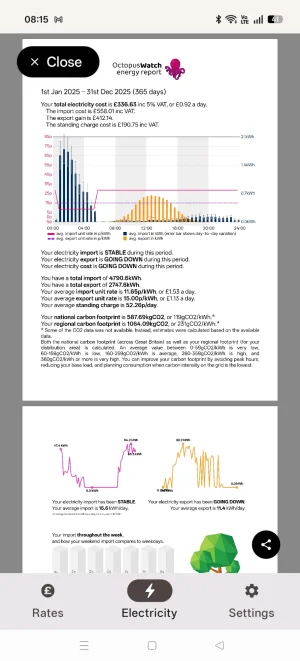
Can I ask what your yearly usage is like for electricity with and without your car?
I use Octopus Watch for creating reports:
 

Attachments

  • Screenshot_2026-03-13-08-15-19-59.webp
    Screenshot_2026-03-13-08-15-19-59.webp
    127.6 KB · Views: 5
I’m not entirely sure why you are disagreeing with me as your saying pretty much the same thing in a different way?
Oh!... I thought I was just disagreeing with some specific comments that I put in bold...

a) you said "Even if your DNO won’t allow you to have a 5 kW inverter". My clarification was that DNO's do not restrict the output power of a grid-tied inverter; they only restrict the power that you export to the grid. These are not the same. We have over 9kW of inverter output power (for powering the house, charging the EV etc.) yet can only export a fraction of that.

b) you said "the inverter should ideally match the output of the panels ". IMHO, in the UK I would always advocate overpanelling - i.e. the output of the panels (kWp) should ideally exceed the kW output power of the inverter. The exception being if you do not have physical space to do so.

I didn’t know there was an approval process that allows you to have an inverter that is capable of exceeding the DNO export approval but in a restricted mode that allows for self consumption (which is what I think you are saying?).
Yes. That is correct. As part of a G99 approval process the DNO may (and often do) come back with some options if your inverter(s) output exceed the local line capacities. The options are typically:-
1) Use a lower power output inverter (= not ideal as won't be able to power all house loads)
2) Pay the DNO for network reinforcement. (= not ideal as likely to cost upwards of £15,000)
3) Implement G100 export power limitation. (= usually best solution provided your inverter supports such and comms can be established between inverter and incoming supply for the power meter data transfer)

Re these 2 comments...
I’m actually surprised by that as I’d expect it’s relatively easy to change the settings and export more than has been approved?

FWIW I have two inverters in my installation, a Growatt SPH6000 coupled to solar and battery and a Victron Multiplex II connected to a battery. The Growatt system was installed by a 'certified' installer and the Multiplex DIY'd by me including building the battery etc. BOTH system's have export limiting facilities and both are user accessible and I cant see in either system any way to lock it down away from user access

Part of the ENA G100 requirement is that the export power is not easily changed by the end user. Hence the settings should be protected by either password, PIN or physical access that is capable of being sealed. IME, most inverters have a PIN protected 'advanced' or 'engineering' sub-menu where the setting is made. MCS installers should not, therefore, disclose the PIN to the end user. In @johnb80 and my case, we are the installers, so will readily be able to change the value to whatever we like. Not that there would be any financial gain in doing so, as your Export MPAN is associated with a maximum power that can be exported, hence (presumably) one's energy supplier would not pay for export power greater than the Export MPAN is valid for.
 
Oh!... I thought I was just disagreeing with some specific comments that I put in bold...

a) you said "Even if your DNO won’t allow you to have a 5 kW inverter". My clarification was that DNO's do not restrict the output power of a grid-tied inverter; they only restrict the power that you export to the grid. These are not the same. We have over 9kW of inverter output power (for powering the house, charging the EV etc.) yet can only export a fraction of that.

b) you said "the inverter should ideally match the output of the panels ". IMHO, in the UK I would always advocate overpanelling - i.e. the output of the panels (kWp) should ideally exceed the kW output power of the inverter. The exception being if you do not have physical space to do so.


Yes. That is correct. As part of a G99 approval process the DNO may (and often do) come back with some options if your inverter(s) output exceed the local line capacities. The options are typically:-
1) Use a lower power output inverter (= not ideal as won't be able to power all house loads)
2) Pay the DNO for network reinforcement. (= not ideal as likely to cost upwards of £15,000)
3) Implement G100 export power limitation. (= usually best solution provided your inverter supports such and comms can be established between inverter and incoming supply for the power meter data transfer)

Re these 2 comments...


Part of the ENA G100 requirement is that the export power is not easily changed by the end user. Hence the settings should be protected by either password, PIN or physical access that is capable of being sealed. IME, most inverters have a PIN protected 'advanced' or 'engineering' sub-menu where the setting is made. MCS installers should not, therefore, disclose the PIN to the end user. In @johnb80 and my case, we are the installers, so will readily be able to change the value to whatever we like. Not that there would be any financial gain in doing so, as your Export MPAN is associated with a maximum power that can be exported, hence (presumably) one's energy supplier would not pay for export power greater than the Export MPAN is valid for.
Fair enough, but what I wrote that you didn’t put in bold was saying pretty much the same thing when in full context.

The OP has space for 15 panels and I was responding in that context. I didn’t know you could have an inverter that exceeds the DNO limit for export they allow though! I can change the export limit mine has using the app but not beyond what it can actually do.

Anyway, I’m not trying to have an argument it, I was just a bit perplexed! I’m dyslexic so I’m used to people misunderstanding what I’m trying to say.
 
Fair enough, but what I wrote that you didn’t put in bold was saying pretty much the same thing when in full context.

The OP has space for 15 panels and I was responding in that context. I didn’t know you could have an inverter that exceeds the DNO limit for export they allow though! I can change the export limit mine has using the app but not beyond what it can actually do.
Yes, it's good when you need more house / EV charging capability that export allowance.

Anyway, I’m not trying to have an argument it, I was just a bit perplexed! I’m dyslexic so I’m used to people misunderstanding what I’m trying to say.
No, worries - didn't mean to be over-corrective, just felt I should clarify those points for others reading the thread.
 
Support us by becoming a Premium Member

Latest MG EVs video

MG4 EV Refresh + NEW MG4 EV Urban - UK arrival dates, prices, specs (2026)
Subscribe to our YouTube channel
Back
Top Bottom