The story goes, it was meant to signify it was one step ahead of IBM, being 1 letter advanced .....

T1 Terry

It's a Sigenergy 12.5 kW EVDC module which forms part of the Sigenergy stack. From the floor up there are 4 x 8 kWh battery modules (32 kWh), the EVDC unit and on top the 12 kW single phase energy controller/inverter.

View attachment 42140
Being integrated in this manner had advantages/disadvantages. Works well for us as the stack is in the garage.

The charge from solar is great - it's all DC direct, does not go through the inverter which keeps AC power capacity free for regular loads.

It is software upgradable to 25 kW but I have little use for the extra as we are a single phase home with a 63 A service and 14.7 kW of solar PV.

Here is yesterday's power supply and demand. The green block is the car charging, putting ~ 11 kW into the car directly from excess solar. We have a 5 kW grid export limit so often have production curtailed once the home battery is charged.

View attachment 42144
I watch the UK video on this at the 1:48sec mark, check the plug, that is the AC side only, so the DC EV charger is not actually correct. I have no idea how they can push 25kW through the MG onboard AC to DC charger unit to get 400VDC and 62.5 amps into the battery, I believe 7kW is the limit in both directions for the MG onboard unit.

I was hopeful it was a genuine DC direct from the solar to the battery, but without the DC pins in the much larger DC CCS 2 plug, that ain't gunna happen

I believe the disclaimer
*V2X functionality is limited by the EV's capabilities. Once the relevant standards are published, V2X feature can be upgraded through the OTA. For the official support of vehicle models and support timelines, please refer to future announcement made on the official website.

Is referring to the V2G functionality, they are not going to be able to somehow upgrade the unit to charge DC through an AC connection plug with an OTA update ......

T1 Terry
 
1:48sev mark, check the plug, that is the AC side only, so the DC EV charger is not actually correct.
That's clearly just some stock image they cut in and used the wrong image.

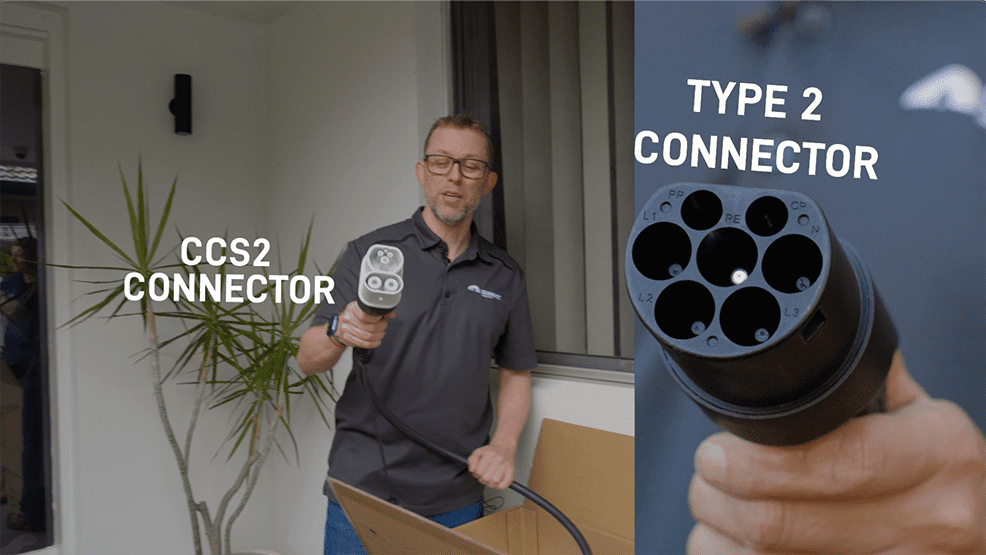
The actual plug is a full CCS2 DC plug, same as any regular highway fast charge station uses.
I have no idea how they can push 25kw through the MG onboard AC to DC charger unit
They don't, as above it's a proper CCS2 plug and connects directly to the battery.

When you initiate a charge session the Sigen DC charging control system establishes communications, checks the insulation protection and then commences charging the battery direct DC.

Here's a pic:
ccs2-vs-type2.png


hmm 25kW @ 250v isn't that 100A?
I had to have the house wiring upgraded to 32A for the 7kW charger.
I have a feeling 100A would need a new 3 phase connection and suitable wiring through the roof.
Installation isn't going to be as simple as shown.
 
Have you actually plugged this into your MG4 and verified it can move the 12kw either way in and out of the MG4 battery?
I'm only using charge from excess solar feature and have limited solar PV capacity and it has regularly charged at well over 10 kW.

With discharging it was just powering the house during a grid outage so power demand never got that high.

Here's a day where sun was coming and going behind clouds, can see it was charging close to its peak charge rate at times:

Screen Shot 2026-01-10 at 5.28.02 pm.webp
 
hmm 25kW @ 250v isn't that 100A?
I had to have the house wiring upgraded to 32A for the 7kW charger.
I have a feeling 100A would need a new 3 phase connection and suitable wiring through the roof.
Installation isn't going to be as simple as shown.
In general if you are expecting/wanting to charge at high power from the grid then you will want a 3-phase system for the extra capacity.

In most scenarios to charge at the full 25 kW requires the system to blend power from PV/battery and the grid, which it can and will do if you tell it to.

I have a single phase home so a 25 kW charger made little sense, 12.5 kW is plenty.

For me it's not the charging speed so much, it's just really good at sucking up excess solar (the extra charge speed is just a bonus) plus it reduces the demand on the AC side (both the PV/battery inverter and the car's on board AC charge unit). And there is no minimum charge rate like there is for AC charging.

Every now and then I may want to charge with free grid power but I can set the charge rate to anything I want, it doesn't need to be the full 12.5 kW.

But importantly for us it also means our two cars can act as reserve capacity for grid outages and fully power our home. I have tested it with both cars and it works fine. We had another grid outage yesterday afternoon. This is our outage experience over the years. We get them pretty regularly.

Screen Shot 2026-01-10 at 5.39.48 pm.webp
 
In general if you are expecting/wanting to charge at high power from the grid then you will want a 3-phase system for the extra capacity.

In most scenarios to charge at the full 25 kW requires the system to blend power from PV/battery and the grid, which it can and will do if you tell it to.

I have a single phase home so a 25 kW charger made little sense, 12.5 kW is plenty.

For me it's not the charging speed so much, it's just really good at sucking up excess solar (the extra charge speed is just a bonus) plus it reduces the demand on the AC side (both the PV/battery inverter and the car's on board AC charge unit). And there is no minimum charge rate like there is for AC charging.

Every now and then I may want to charge with free grid power but I can set the charge rate to anything I want, it doesn't need to be the full 12.5 kW.

But importantly for us it also means our two cars can act as reserve capacity for grid outages and fully power our home. I have tested it with both cars and it works fine. We had another grid outage yesterday afternoon. This is our outage experience over the years. We get them pretty regularly.

View attachment 42564
108 outages in 7 years!!

Wow, no wonder this is important to you. I have had zero power outages in the same time. Grid power has been on continuously for 10 years.
 
I'm only using charge from excess solar feature and have limited solar PV capacity and it has regularly charged at well over 10 kW.

With discharging it was just powering the house during a grid outage so power demand never got that high.

Here's a day where sun was coming and going behind clouds, can see it was charging close to its peak charge rate at times:

View attachment 42563
Just so I can get my head around it, what DC voltage is coming in from the solar?
I can see from the CCS 2 plug that there is an earth pin and the two signal terminals, but no AC terminals. So the two way is DC, I will have to make adjustments and retractions in my posts.

If I'm getting this part correct, the solar is boosted to 400vdc for charging, then the 300 and what ever DC volts can flow back out of the battery and the inverter makes 230vac from what ever the DC voltage is from the EV battery ..... did I get that part correct?

T1 Terry

I watch the UK video on this at the 1:48sev mark, check the plug, that is the AC side only, so the DC EV charger is not actually correct. I have no idea how they can push 25kw through the MG onboard AC to DC charger unit to get 400vdc and 62.5 amps into the battery, I believe 7kw is the limit in both directions for the MG onboard unit.

I was hopeful it was a genuine DC direct from the solar to the battery, but without the DC pins in the much larger DC CCS 2 plug, that ain't gunna happen

I believe the disclaimer
*V2X functionality is limited by the EV's capabilities. Once the relevant standards are published, V2X feature can be upgraded through the OTA. For the official support of vehicle models and support timelines, please refer to future announcement made on the official website.

Is referring to the V2G functionality, they are not going to be able to somehow upgrade the unit to charge DC through an AC connection plug with an OTA update ......

T1 Terry

Well, I'm going to have to take all that rant back ...... Caught by a You Tube video maker making it up as he goes .....
@wattmatters actually has one of these installed and has a graph showing the solar actually DC charging the EV battery ......

It does appear like the whole unit must be installed close to where the EV will be charged ..... something to think about .....

T1 Terry
 
It does appear like the whole unit must be installed close to where the EV will be charged

The stack is on the back wall of the garage. Modules from bottom up, 4 x battery modules, EVDC module, energy controller (inverter) on top. That's the DC cable you can see, it's plugged into my MG4. Cable is 10 m.

IMG_1763.webp
 
Just so I can get my head around it, what DC voltage is coming in from the solar?
There will be several voltages, we have three separate arrays each of different size, each connected into its own MPPT (one spare unused MPPT) in the Energy Controller.

If I'm getting this part correct, the solar is boosted to 400vdc for charging, then the 300 and what ever DC volts can flow back out of the battery and the inverter makes 230vac from what ever the DC voltage is from the EV battery ..... did I get that part correct?
The system has a higher voltage DC bus, each battery module has its own DC-DC voltage buck/boost converter. The modules are made up of 9 x LFP cells in series. MPPTs would manage the solar and of course there is an inverter and charge controller.
 
The description is also wrong ... HAL are each 1 letter behind IBM. ;)
but behind is ahead, depends how you look at it, H come before I, A comes before B and L comes before M.

Z is the tail end of the pack, it's coming last. A is ahead of the pack it's coming first.
 

Are you enjoying your MG4?

  • Yes

    Votes: 1,055 77.6%
  • I'm in the middle

    Votes: 206 15.2%
  • No

    Votes: 99 7.3%
Support us by becoming a Premium Member

Latest MG EVs video

MGS6 deep dive + MG2 rumours, MGS9 PHEV preview and Cyber X tease
Subscribe to our YouTube channel
Back
Top Bottom